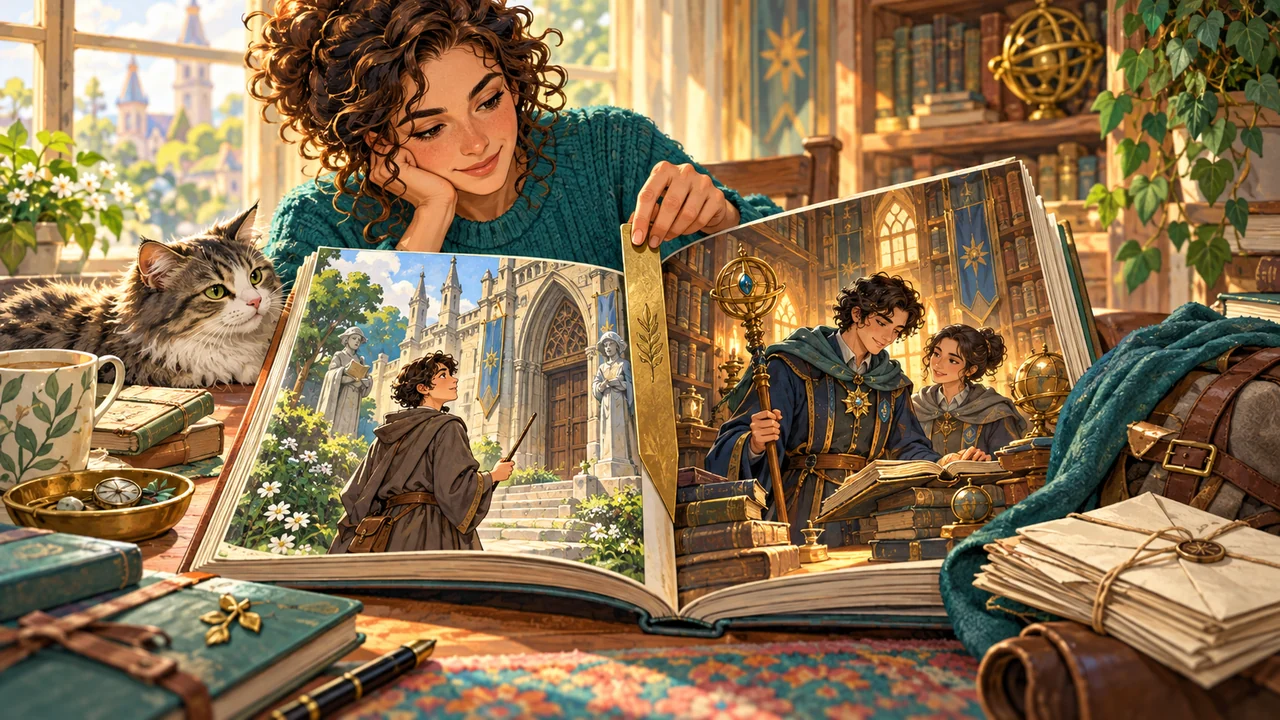
He Became a Court Mage Again, but He Did Not Return to His Old Life
Noah began as a human apprentice mage.
He lived in a frontier city and belonged to no important organization. He knew only a handful of spells and understood nothing about the rules of the royal court.
Years later, he completed his trials, entered the capital, and became a court mage.
His new identity granted him access to the Royal Library. It also placed him under court law and royal command. He joined the Order of Court Mages, received a staff, a badge, and a residence in the capital, and established relationships of rank and cooperation with other members of the order.
Then a failed ritual changed him.
Noah lost his human identity and became an undead warlock.
His vital state, abilities, restrictions, and the way the world regarded him all changed. Some privileges associated with being a court mage ceased to apply. Corruption and hunger became new burdens.
The Order of Court Mages expelled him.
He could no longer enter the capital freely.
Some people continued to trust him.
Other relationships shifted from cooperation to suspicion, fear, and hostility.
Much later, Noah broke the curse.
He became a court mage again and was readmitted to the order.
From the perspective of a character profile, his class appears to have traveled in a circle:
human apprentice mage
→ court mage
→ undead warlock
→ court mage
But the court mage at the end is not the same person who first became a court mage.
He has been exiled.
He has lost privileges.
He has carried possessions away with him.
His relationships have changed.
He also bears consequences that could exist only because he once lived as an undead warlock.
He returned to his former class.
He did not return to his former life.
The Same Identity Does Not Mean the Same World State
If a character sheet preserves only the latest class, Noah’s first and second periods as a court mage can easily appear identical.
The class is the same.
The species is the same.
The name is the same.
Even his faction membership may eventually become the same again.
But the world cannot place those two periods on top of each other.
When Noah first became a court mage, he may not yet have known the allies he would meet later.
He had not experienced exile.
He had not encountered the forbidden ritual.
He did not carry the relationships and debts left by his undead identity.
When he becomes a court mage for the second time, all of that history still exists.
Some people know that he was once undead.
Some do not believe he has truly been restored.
He may receive a new court badge without immediately recovering all his former privileges.
The mage order may accept him even though the royal family has not forgiven him.
A shared class name tells the world how it currently recognizes him.
It cannot erase how he arrived at that identity.
This is why a class change should not simply overwrite a character sheet.
If every change preserves only the latest answer, the character will appear to keep updating while their history gradually disappears.
Real character growth does not replace an old version with a new one.
It makes the new identity inherit the world left behind by the old one.
Race and Class Are Ways the World Recognizes a Character
Race, species, lineage, and class can represent different concepts in worldbuilding.
Race or species may describe ancestry, biology, physical structure, or innate abilities.
Class may describe training, occupation, social position, and the methods available to a character.
From the perspective of world state, however, they answer a shared question:
What kind of being does the world currently recognize this character as?
A human mage and an undead mage may use different attributes and face different restrictions.
A court mage and a wandering mage may know the same spells without possessing the same privileges.
A knight who has left the order may retain their combat abilities but no longer have the authority to issue commands in its name.
These identities cannot always be separated into clean, independent fields.
A character may also be shaped by the combination of species and class.
InkWeave therefore treats race and class as forms of identity archetype.
A creator can define a human apprentice mage.
They can define a court mage.
They can also define a combined identity such as an undead warlock, in which species and class change together.
This does not mean that race and class have no distinction inside the story.
It means the creator decides how precisely the world needs to recognize a character.
If race and class must produce separate consequences, the creator can build more specific identity combinations.
If the story only cares about the character’s current profession, the creator can define only the professional identities it needs.
InkWeave does not prescribe how a world must classify its characters.
It provides identities that can change over time and be recognized by the causality engine.
Initial Identity Is a Starting Point; Class Changes Create History
Noah’s character data can preserve his initial identity:
human apprentice mage.
This establishes how the world recognizes him before any identity-changing event occurs in the manuscript.
When he completes his trials, the creator can place an identity-change event at the exact point where that change becomes real.
From that position onward, Noah is a court mage.
Before that position, he remains an apprentice mage.
His transformation into an undead being is another event.
It does not rewrite his birth.
It does not introduce corruption and hunger into chapters that occur before the failed ritual.
Only after the manuscript reaches that event does the world begin to recognize him as an undead warlock.
Becoming a court mage again after breaking the curse is a third identity event.
It does not delete his undead identity from history.
It does not cancel the previous transformation.
It changes his current identity again at a new point in time.
A complete identity history is therefore not a list with only the latest option selected.
It is an ordered sequence of changes:
human apprentice mage
→ court mage
→ undead warlock
→ court mage
Every arrow represents an event that actually happened in the world.
If the creator returns to an earlier chapter and moves the curse event further back, the point at which Noah becomes undead also changes.
If that event is removed, his later identity cannot continue pretending that it still has the same causal source.
The world preserves more than who he is at the end.
It preserves the moment at which he stopped being who he was before.
A Class Change Determines Which Attributes Apply
If changing class alters only a name, its effect on the world remains limited.
What makes identities meaningfully different is the set of attributes, privileges, and restrictions that apply to each one.
Some attributes can apply to every character.
Health.
Stress.
Reputation.
Fatigue.
Injury.
These states do not necessarily disappear when a character changes class.
An injury Noah suffered as a court mage does not automatically heal when he becomes an undead warlock.
Reputation, hostility, and relationships accumulated in the past do not necessarily reset either.
Other attributes are meaningful only to particular identities.
An apprentice mage may have trial progress.
A court mage may have court trust or merit within the mage order.
An undead warlock may need to endure corruption, hunger, or physical decay.
These values do not need to appear on every character.
An ordinary merchant does not need an undead hunger attribute.
A mage who has never joined the court may not need court merit.
InkWeave allows creators to define attributes shared by every character. It also allows attributes to belong only to particular race and class identities.
When the causality engine derives Noah’s identity at the current manuscript position, the Inspector can present the attributes that apply to that identity.
When the cursor is in his apprentice period, the author sees the states relevant to the apprentice he was then.
Only in his undead period do corruption and hunger become attributes that need to be observed in the current world.
When he becomes a court mage again, the attributes associated with that identity return to the current view.
Earlier attribute history is not rewritten merely because an attribute temporarily stops applying.
Identity determines which attributes are meaningful at a particular moment.
Events determine the values those attributes hold at that moment.
Becoming a Court Mage Does Not Make Everything Else Happen Automatically
An identity change matters.
But it cannot decide every other event in the world.
Noah becoming a court mage does not mean he has already joined the Order of Court Mages.
He may have passed the qualification process but refused the appointment.
He may have acquired the professional identity while still waiting for organizational approval.
He may already belong to the order but have not yet entered the capital.
Likewise, becoming an undead warlock does not mean that all his friends immediately know.
It does not mean the order has already expelled him.
It does not return his court badge to the royal family automatically.
It certainly does not turn every relationship hostile at the same moment.
These are separate changes to world state.
A class-change event alters the character’s identity.
A faction event determines whether they belong to the Order of Court Mages.
A flag or condition can represent whether they may enter the Royal Library.
An item event determines who currently holds the badge.
A movement event determines whether the character is in the capital, at the frontier, or in exile.
Whether other people know the truth, and whether their relationships with Noah have changed, must also be established explicitly by the author when those states matter.
This separation is not an attempt to make one event unnecessarily complicated.
It preserves possibilities for the story.
Noah can become undead while continuing to disguise himself as a court mage.
He can be expelled from the order while still carrying its badge.
He can recover his human identity without recovering anyone’s trust.
If a class change automatically completed every related consequence, none of these stories would have room to exist.
The world must acknowledge that Noah’s identity changed.
Only the author can decide when other people discover that change and which consequences actually follow.
As the Cursor Moves, the World Recognizes Who He Was Then
When the author places the cursor near a passage in which Noah is still an apprentice mage, InkWeave should not answer questions using an identity he acquires later.
The AVG Stage and Inspector need to present Noah as he exists at that point in time.
He has not yet become a court mage.
He has not acquired his later identity.
Attributes that apply only to an undead warlock do not yet apply to him.
Only after the cursor passes the court mage identity event does the world begin using that new identity.
Only after it passes the curse event does Noah become an undead warlock.
The world does not recognize him as a court mage again until the curse is broken and the later class-change event has occurred.
This is not a character profile switching between several manually saved versions.
InkWeave’s causality engine starts with the character’s initial identity and replays each subsequent identity change in manuscript order.
It calculates only as far as the current position.
The creator can therefore see more than the character’s latest identity.
They can open the identity history to inspect where each class change occurred, which identity it established, and how the character became the person they are now.
The fact that “court mage” appears twice does not erase the undead history between those periods.
The engine calculates an ordered series of events.
It does not guess which category a character belongs to from their name or description.
This Is Not AI Deciding a Character’s Class
The manuscript might say:
Noah raised his staff like a court mage.
That does not mean he has become a court mage.
It might also say:
He had not been human for a long time.
The sentence might be a metaphor.
It might be an insult.
It might be a lie.
Or it might indicate a genuine transformation of species and vital state.
InkWeave does not send these sentences to AI and ask it to guess whether the author is changing Noah’s class.
It also does not modify a character’s identity merely because a class name appears near that character in the manuscript.
The creator first defines the identities the world needs, including its races, species, lineages, and classes.
When a class change, transformation, curse, restoration, or other identity change actually takes place, the creator places a confirmed identity event at the correct position in the manuscript.
InkWeave’s self-developed causality engine then derives the identity that should be valid at the cursor from the character’s initial identity and the ordered events that follow it.
The same initial configuration, identity events, event order, and attribute rules produce the same result.
Within that explicitly modeled boundary, the result is mathematically guaranteed.
It is not a language model’s interpretation of the character.
It is the world state produced by deterministic replay of modeled identity events.
The system does not judge whether Noah looks enough like a court mage.
It answers a narrower and more reliable question:
According to the events the author has actually confirmed, is he a court mage at this point in the world?
A Real Career Change Is More Than Editing a Job Title
The same identity model can describe a real career.
An employee begins as an HR specialist.
They later become an executive assistant.
They then transfer into sales.
Years afterward, they return to human resources.
Their latest job title may resemble the one they held at the beginning.
Their world state does not return to their first day at the company.
They have established new relationships.
They have belonged to different departments.
They have gained and lost different privileges.
They have accumulated experience, reputation, and responsibility in other roles.
If they return to HR as a manager, they re-enter a familiar profession from a different position in the organization.
In this model, professional identity and department membership should not be compressed into one field.
An HR specialist may be assigned to a cross-department project.
An executive assistant may belong to the Executive Office or serve another organization.
A sales professional who transfers into an administrative department may retain sales expertise while occupying a new faction position.
InkWeave is not an HR management system.
It does not process payroll, insurance, regulatory filings, or corporate accounts.
But it can simulate the causal structure shared by these situations:
When did a person change roles?
When did they join or leave an organization?
Which attributes applied at that time?
How should the world recognize that person at any point in the event sequence?
A Believable Character Carries Every Former Self Forward
The identities of fictional characters can change far more dramatically than real careers.
A human can become undead.
A soldier can become a king.
A priest can lose their faith.
An enemy commander can join the protagonist’s faction.
A mage can abandon magic, live as an ordinary person, and take up the staff again years later.
If these changes exist only in a character description, the character receives little more than a continuously updated business card.
The abilities, privileges, restrictions, and relationships that once applied can easily be washed away when a new description replaces the old one.
But a character who has truly lived does not begin again with every class change.
They carry what one identity left behind into the next.
An exile who was once a king is different from an exile who has never ruled anyone.
An undead being restored to humanity may still carry relationships and guilt created during their undead life.
A former traitor who returns to the mage order does not automatically recover everyone’s trust simply because the class name has been restored.
Identity can change how the world responds to a character.
History explains why that response cannot be determined by the identity name alone.
InkWeave makes race and class part of world state that can change over time.
Shared attributes continue carrying the results accumulated throughout the character’s life.
Identity-specific attributes enter the current world only during the periods in which those identities truly apply.
A character can change class.
They can transform.
They can lose an identity.
They can even become someone they once were.
But the world does not forget what happened in between.
An identity can become the same again.
History does not move backward with it.