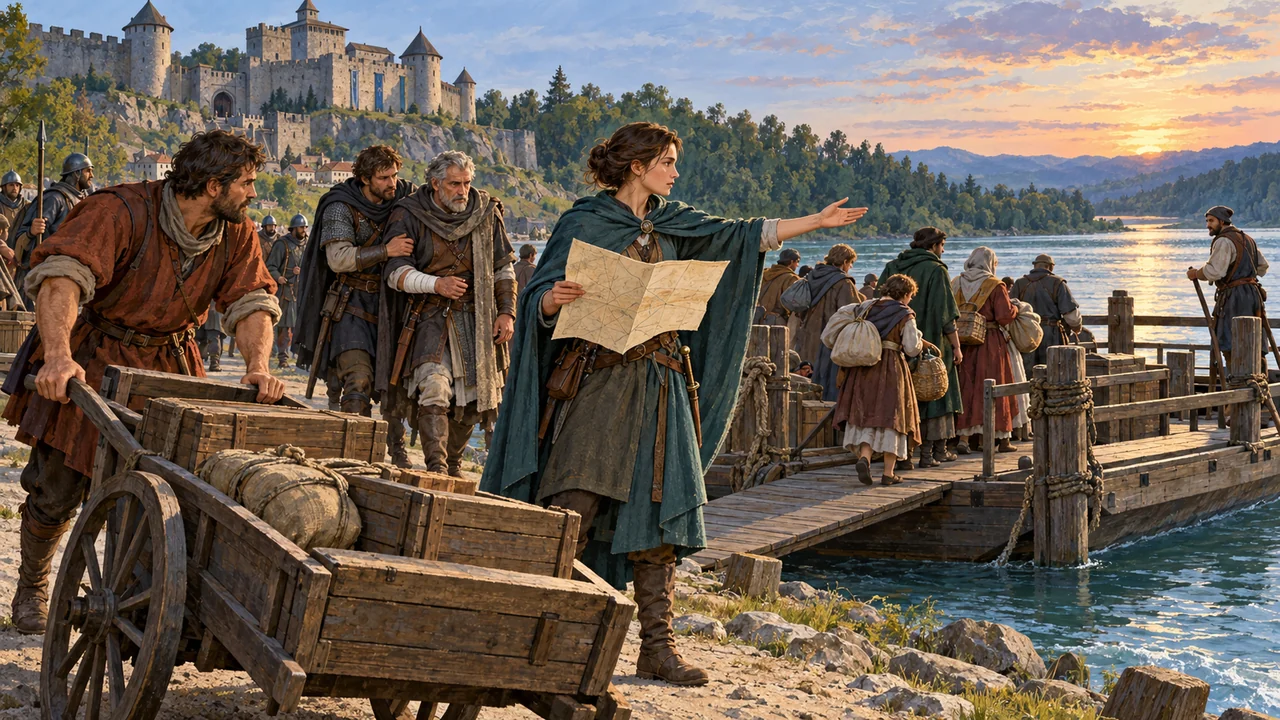
Rivermouth Fort must hold until dusk.
Not because its defenders have to defeat the enemy here, but because residents are still waiting at the ferry crossing.
If the defenders hold the walls but lose the crossing, the mission can still fail. If the fort falls after the residents and most of the garrison reach the north bank, “defeat” alone doesn’t explain the outcome.
Intense combat can keep readers on edge. But a military campaign also needs people with reasons to fight, the means to continue, and circumstances that make them change their plans.
To design a military campaign, establish both sides’ objectives first. Use terrain, time, supplies, and intelligence to limit their choices, then ask how each engagement changes what they can do next.
This guide links supply runs, the defense of Rivermouth Fort, a river withdrawal, and regrouping on the north bank into a campaign serving one evacuation mission. It isn’t the entire war, nor simply a longer account of a single assault.
You can use the worksheets and methods below to plan your story. At the end, we’ll follow the same campaign in InkWeave to see how supplies, locations, command, and prerequisites leave visible consequences as you write and revise.
Contents
- Define what both sides need to achieve
- Let terrain, time, and supplies limit choices
- Separate what is happening from what characters know
- Make combat force character choices
- Separate winning ground from completing the mission
- Carry the aftermath into the next chapter
- A military campaign worksheet for your novel
- War fiction and campaign design FAQ
- Follow the campaign’s consequences with InkWeave
Define what both sides need to achieve
“The defenders fight the attackers” doesn’t yet explain a campaign.
Ask what each side wants to gain, and what they intend to do once they have it.
In this fictional example, Rivermouth Fort controls the main road to the ferry crossing. Going around it isn’t impossible, but takes longer. The defenders want to use that time to get residents to the north bank. The attackers want to seize the crossing, stop the evacuation, and control later movement across the river.
The fort matters for more than the height of its walls.
It gives some people time to leave while keeping others from completing their own operation.
| What needs deciding? | Rivermouth’s defenders | The attackers |
|---|---|---|
| The operation’s objective | Cover the residents’ crossing while preserving a chance for the garrison to withdraw north. | Seize the crossing, stop the evacuation, and control later passage. |
| Why the fort matters | It holds up the main threat approaching the crossing. | Taking it removes the defenders’ control of the direct route to the crossing. |
| What counts as success | The residents escape and the troops can disengage as planned. | Gain control of the key route before the evacuation is complete. |
| What would force a change of plan | Reinforcements fail to arrive, supply is cut off, or the evacuation arrangements stop working. | The assault takes longer than expected, or the residents have already crossed. |
| What each side wants to retain afterward | People, essential supplies, and the ability to keep protecting the residents. | A stronghold, control of passage, and the ability to keep pressing north. |
Neither side needs to get everything it wants.
The attackers can take the fort without stopping the residents’ escape. The defenders can complete their covering mission while losing a position they won’t soon recover.
Characters can also disagree about what the mission means.
Commander Aiden believes they should leave once the residents are clear. Some soldiers fear that withdrawal will be seen as abandoning their homes. His deputy, Leah, needs to understand those disagreements: she will later have to lead the same people out.
Establish objectives and disagreements first, and readers can understand what people are fighting for instead of waiting for you to announce a winner.
Let terrain, time, and supplies limit choices
Having an objective doesn’t mean a character can simply choose the most convenient way to achieve it.
You need a few constraints that change their choices, not a military map of the entire continent before you begin.
For Rivermouth, readers need to understand a handful of places: the rear supply depot, the fort, the ferry crossing, and the north-bank camp. Moving between them takes time, and enemy activity affects some routes.
| Constraint | What does this example need to establish? | How does it enter the story? |
|---|---|---|
| Terrain and routes | Which road does the fort control, and how can people cross the river? | Wanting to withdraw doesn’t put characters on the north bank. |
| Time | How much longer will the evacuation take, and when might the enemy reach the crossing? | The defenders must judge whether they can wait or need to adjust. |
| Supply | Which goods have arrived, and can further deliveries continue? | Having food today doesn’t make a prolonged defense sustainable. |
| Transport and carrying capacity | How will people, casualties, and supplies leave? What is difficult to move? | Withdrawal involves choices; it doesn’t move every resource out together. |
| Command and coordination | Who covers the retreat, transports supplies, confirms reports, and leads the troops? | One important character’s injury can change several people’s duties. |
For example, Cass, the quartermaster, has delivered a shipment of food to the fort.
But the route for further deliveries is obstructed. This shipment doesn’t mean the supply problem is solved for good. The defenders need to know whether more will arrive and whether holding the fort will use up provisions they need after withdrawing.
Transport isn’t just background, either.
Cass can leave food for those covering the withdrawal or move some to the crossing first. Either choice may make sense. What matters is who needs it later, whether they can still get it, and who has to move it.
Constraints aren’t there to show off how much research you’ve done.
They should help readers understand why the characters can’t hold the fort, protect everyone, take every supply, and avoid all risk at once.
Writing note: Important supplies don’t require a ledger for every meal
Focus on the goods, routes, and timing that affect choices. You don’t need to record every passing meal. The crate counts later in this guide illustrate one important shipment’s movements, not how many days a given force can eat. If the plot depends on precise consumption rates, research them and establish quantities that fit your world.
Separate what is happening from what characters know
Knowing as the writer that reinforcements won’t arrive on time doesn’t mean the front line knows it.
A dispatch reaching the front doesn’t mean every squad has read it immediately.
Decisions in a campaign need to follow the information characters have at the time, not the complete situation you know as the writer.
Separate three things: what happened, who received the news, and what they changed because of it.
| Situation or report | Who knows, and at what stage? | Which decision might change? |
|---|---|---|
| Expected reinforcements won’t arrive on time. | Noren, the messenger, learns first. He confirms the news to Aiden and Leah after reaching the fort. | They can no longer count on the promised reinforcements to sustain their defense. |
| Further supply runs are obstructed. | Cass discovers the problem, then reports it to those in command. | Existing goods need reallocating rather than being used according to the old plan. |
| The last residents haven’t left the crossing. | People at the crossing know the progress, but must get word to the fort. | The garrison can’t base its full withdrawal on “they should be clear by now.” |
| The evacuation is complete. | Once confirmation returns, those covering it can adjust. | Holding to buy time gives way to disengaging and regrouping. |
Reports can arrive late, be misread, or be deliberately withheld.
But those changes should affect people in concrete ways.
If Noren arrives late, Aiden may wait longer than intended. If the report is ambiguous, Leah might make preparations she can still reverse rather than ordering a full withdrawal at once.
Every change in intelligence needn’t be a conspiracy.
Blocked roads, incomplete messages, and people handling different tasks with different pieces of information can make coordination difficult enough.
The attackers shouldn’t always know the defenders’ whole plan, either.
Seeing supplies move might change their direction of advance. If they discover only after taking the fort that the residents have escaped, they will need to reconsider their next objective.
Intelligence changes a campaign through more than the discovery of a secret. It can make the old plan unreasonable from the moment someone receives it.
Make combat force character choices
Once the planning is done, the campaign still has to become something people experience.
If each combat passage only adds casualties, without changing methods, duties, or objectives, even intense fighting can become repetitive.
Let each important sequence change at least one thing.
Someone loses a position they could use before.
Someone receives new information.
Supplies have to move earlier than planned.
A person who isn’t ready has to take responsibility.
| What is the character facing? | What choice do they need to make? | What is different afterward? |
|---|---|---|
| Aiden is injured and can’t keep commanding from his position. | Struggle to stay, or make an explicit handover and withdraw north? | Command changes; the character hasn’t merely acquired another wound. |
| Leah takes over before the residents are clear. | Who leaves first, who covers them, and how will she confirm the remaining progress? | The troops move in stages instead of everyone appearing in the next scene together. |
| Cass can’t take every piece of equipment. | Which goods deserve transport space, and which must stay at the fort? | Resources available afterward change; abandoned items may fall into enemy hands. |
| Residents have to leave their homes. | Wait for more family members, retrieve a possession, or accept the available passage? | Those rescued still experience loss and may have mixed feelings toward their rescuers. |
Choices don’t all need long conversations to convey them.
Aiden can give Leah his folded map, confirm that she understands the withdrawal arrangements, then accept a companion’s help walking away. That can show trust, physical limits, and a handover in the same scene.
But handing over the map is only part of what happens.
Leah still needs a clear assignment, and others need to know who now commands them. Holding an important object doesn’t automatically transfer everyone’s responsibilities with it.
Point of view also determines which part of the campaign readers see.
Cass sees food crates not yet loaded and a column that can’t wait. Leah sees covering troops who haven’t reported back. A resident may see only that the ferry has arrived but a family member hasn’t.
You don’t have to give every viewpoint equal space.
Choose the perspective that makes the immediate trade-off clearest, then give readers enough information to understand the situation. Even following one character, they can sense the wider operation through the problems that person has to solve.
Separate winning ground from completing the mission
Rivermouth Fort falls.
But the residents reach the north bank, and Leah regroups there with the troops and essential supplies that got out.
That isn’t simply renaming a defeat as a success.
The defenders really have lost the fort, and the attackers really have gained a position. But neither side’s objectives began and ended with possession of a building.
Look at the outcomes separately.
| What are you assessing? | Outcome for the defenders | Outcome for the attackers |
|---|---|---|
| Ground and passage | They abandon the fort and can no longer use the old routes as before. | They gain the fort and its position, allowing them to arrange their next moves. |
| The original mission | They successfully cover the residents’ evacuation. | They fail to stop this evacuation in time. |
| People and organization | They have wounded people, a change in command, and troops who need reorganizing. | They must arrange occupation and further movement while bearing their own losses. |
| Resources and ability to act next | They preserve some goods but lose equipment and facilities left at the fort. | They may acquire abandoned resources without gaining everything they expected. |
| How people interpret the result | Some praise the evacuation; others still find the loss of their homes unacceptable. | Some celebrate taking the fort; others ask why the original objective wasn’t achieved. |
A retreat can complete a mission. It can also be only the less costly outcome.
Not every withdrawal has to turn out to be a cleverer kind of victory.
You might leave some residents behind or let the garrison save its people while losing supplies it needs later. The result should follow from earlier choices and circumstances, rather than a closing declaration that everything was for the best.
Characters don’t have to agree on the outcome, either.
Aiden can believe he made a necessary choice. Someone whose home is across the river can still ask why he couldn’t hold a little longer.
Let those different results coexist, and the campaign can keep generating story beyond a ceremony of rewards or punishments.
Carry the aftermath into the next chapter
Ending the campaign doesn’t restore the world to how it was before the operation.
The people, resources, locations, and relationships the next chapter uses need to follow from this operation.
| What has the campaign changed? | What must the next chapter deal with? |
|---|---|
| Aiden withdraws wounded; Leah takes over in the field. | He is alive and may still belong to the organization without continuing the same field duties. |
| Some food has been consumed and some moved north. | The same supplies can’t remain intact at the fort while also appearing at the north-bank camp. |
| Equipment has been left behind. | Whether the garrison retains the same capabilities, and whether the enemy acquires the equipment, need further arrangements. |
| Residents have left home. | Shelter, separated families, trust in commanders, and where to go next remain unresolved. |
| The fort has changed hands. | Returning characters won’t encounter the old familiar garrison arrangements. |
| The attackers gain a position without achieving every objective. | They adjust their plan rather than ceasing to act when this scene ends. |
Some consequences appear immediately. Others take longer.
When Cass opens the food crates on the north bank and finds less available than expected, it affects the next arrangements directly. Residents’ views of the evacuation may sharpen while they wait for shelter and hear new orders.
Don’t treat every casualty as the same kind of departure, either.
Someone wounded but alive may be temporarily unable to carry out their old duties. A missing person’s whereabouts remain uncertain. Death permanently removes a participant from some possible futures. Each leaves different questions for people and organizations.
This example leaves Aiden injured rather than dead to preserve another kind of aftermath.
He can see how Leah takes over, agree with or challenge her arrangements, and eventually face the question of whether to resume command when he recovers.
The aftermath isn’t just a way to add sorrow. It brings characters into the next part of the story with circumstances the fighting has changed.
A military campaign worksheet for your novel
Fill out a table first, then break the campaign into scenes.
You don’t need every movement in every engagement decided in advance. You should know which changes will force people to choose again.
| Field | Rivermouth example | Questions for your story |
|---|---|---|
| Scope | Supply runs, holding the fort, withdrawal across the river, and regrouping north. | Are you designing one battle, a connected operation, or the entire war? |
| Both sides’ objectives | Cover an evacuation versus seize the crossing in time to stop it. | What does each side want, and why does it need it now? |
| Why the location matters | The fort controls a road; the ferry provides passage to the north bank. | Why can’t people simply go around or choose another place? |
| Main constraints | Time, transport, supplies, and coordination. | Why can’t the characters preserve everything at once? |
| Unequal information | Expected reinforcements won’t arrive on time, and word must reach the front. | When do characters learn what you already know? |
| Changes that force a new plan | The report is confirmed, Aiden is wounded, and evacuation updates arrive. | What makes the original plan untenable? |
| Central trade-off | Give up the fort while preserving people and some supplies. | What do characters gain, and what do they genuinely lose? |
| Operational outcome | A lost position, residents evacuated, and regrouping on the north bank. | Do territory, mission, and future capabilities produce different answers? |
| Questions afterward | Wounded people, command, civilian shelter, and further supply. | Which changed circumstances can’t the next chapter ignore? |
Then check:
- If you removed one combat sequence, would the later choices stay exactly the same?
- Does important information actually arrive before characters use it?
- Do supplies, wounded people, and other personnel have a way to leave their old locations?
- Does a change in command affect duties, rather than only replacing a name?
- Have you automatically treated retreat as wisdom and holding ground as stupidity?
- Does the result change the next part of the story, not just what readers call victory or defeat?
An episode that doesn’t change the outcome can still develop character, atmosphere, or the experience of war. But you don’t need repeated engagements doing the same job merely to make the campaign seem large.
War fiction and campaign design FAQ
Do I need to research an entire military system before starting?
No. Establish the mission, constraints, and division of responsibilities your story needs, and you can start planning.
If you use a particular real-world period, army, or technology, though, verify its institutions, transport, and ways of fighting. An invented setting should follow its own rules too. A writing worksheet can’t replace research; it can help identify what actually needs researching.
Does a fantasy world with magic still need logistics?
Start with what your magic can and can’t solve.
If it can transport goods instantly, the qualifications, materials, locations, or costs required may become new constraints. If it can solve a problem outright, let the world recognize that ability. Don’t forget it whenever the plot needs a difficulty.
You don’t have to import real-world military conditions into every fantasy setting. Abilities and limitations should both affect choices and remain consistent.
Can readers understand the campaign if I follow only one soldier?
Yes. They don’t need every deployment to understand that person’s mission, immediate obstacles, and how new information changes their next step.
Orders, supplies, casualties, and evacuation arrangements can bring the wider situation into that soldier’s view. You need enough background to support cause and effect; neither the character nor the reader needs to know all of it at once.
Follow the campaign’s consequences with InkWeave
The objective table, information table, and aftermath checklist above can help you design this operation first.
If you want to see people and supplies change as you write, and learn which arrangements lose their causes after a revision, you can bring the important parts of Rivermouth into InkWeave.
You don’t need to create every soldier in both armies first.
Aiden, Leah, Cass, Noren, a few important locations, one food shipment, and a folded map are enough to give this campaign visible feedback.
Watch supplies move from the depot to the camp
Suppose you choose to track one important food shipment in this part of the story: twelve crates.
They begin at the rear supply depot. Cass collects them, takes them to Rivermouth Fort, and deposits them in its inventory. During the defense, you record six crates being consumed. When the garrison withdraws, Cass takes the remaining six and deposits them at the north-bank camp after arriving.
Each event stays at the point where the change actually happens.
| Where is the cursor? | Where is the recorded food? | What can you confirm? |
|---|---|---|
| Before transport begins | All twelve crates remain at the rear depot. | The later delivery has an explicit source instead of appearing when needed. |
| After Cass collects the shipment | Cass has the twelve crates for transport. | They have left the depot without automatically entering the fort’s inventory. |
| After he deposits it at Rivermouth | Twelve crates are at the fort. | Cass doesn’t have to keep them among his possessions. |
| After you record six crates being consumed | Six crates remain at the fort. | Consumed supplies don’t reappear with a new chapter. |
| After Cass collects the remaining food | The six crates go with Cass; this remaining shipment is no longer at the fort. | Withdrawal changes where supplies can be obtained later. |
| After he deposits them at the north-bank camp | Six crates stay at the camp. | A character leaving later doesn’t take the camp’s entire inventory along. |
Characters and locations hold the supplies. The garrison can exist as an organization without treating its name as a physical storehouse for food crates.
The scene-aware view and Inspector beside your writing show characters, items, and locations as they were at the cursor’s point in the story. Add images, and Cass, the fort, the provisions, and the north-bank camp can have recognizable appearances too.
When Cass and an item form a supported interaction, the event wizard can first show its state at that point. You can confirm an acquisition, placement, or transfer, or leave it as a mention.
As you write his withdrawal, you don’t have to maintain several separate “latest inventory” tables. Once you confirm the collection of six crates, his inventory and the fort’s contents reflect that choice. Move the cursor back, and you can see the supplies before they left.
To find out where the camp’s food came from, consult the item’s transfer history or the location’s item history, then jump back to the relevant chapter and event.
Not every logistical detail has to become a record. Track just the shipment that matters later, and you can follow it through the adventure: from the depot to the front, then out again with your characters.
An injured commander doesn’t disappear from the story
You can create the Rivermouth Garrison as a faction, recording Aiden, Leah, and other important members’ positions, leadership, and reporting lines.
After Aiden is wounded, you can keep him alive and retain his membership, then arrange Leah’s takeover at the handover point. Adjust titles, leadership, and reporting lines as needed. This doesn’t mean marking Aiden dead or automatically appointing Leah because she receives the map.
The injury can remain in the prose. Custom attributes are only necessary if you want to keep tracking stamina or another relevant value.
| Where is the story? | Character locations and status | What can the organization and item records show? |
|---|---|---|
| Before the handover | Aiden is still commanding at the fort. | The earlier leader, reporting lines, and holder of the map. |
| After you confirm the handover and map transfer | Aiden is alive, but his field duties have changed. | Leah holds the map; the organization chart updates through the separately confirmed personnel events. |
| After Aiden withdraws north | He and Leah, who remains at the fort, are in different places. | Leaving the scene doesn’t automatically mean leaving the organization. |
| After Leah leads the troops to the north bank | People who arrived at different times are together again. | Membership, those present, and the items brought back reflect the regrouping. |
The organizational history lets you revisit the handover that changed command. Returning the cursor to before the fighting doesn’t apply the later leader to that earlier point.
Injury, a handover, a map transfer, and withdrawal can form a continuous sequence of consequences, rather than one sentence added to a biography: “Leah later took over.”
What happens to the fort also needs a distinction.
Location note: Capture, closure, and destruction are different changes
The enemy occupies the fort in this example, but the building isn’t automatically destroyed. If control of it matters later, you can define that as a story flag and check it where needed. It doesn’t automatically create entry permissions based on faction membership. Use location states such as No Entry, No Exit, Sealed, or Ruin only when the corresponding change actually happens in your story.
Record decision-changing reports as explicit conditions
Not every letter needs a flag.
If a later arrangement genuinely depends on confirmation that reinforcements will be late or that the residents are clear, record that result where the relevant people actually confirm it.
| Which later arrangement needs a prerequisite? | What must happen earlier? | Which condition can you record? |
|---|---|---|
| Leah adjusts the plan because reinforcements won’t arrive on time. | Noren delivers the report, and the relevant people confirm its contents. | Set a flag such as “Front line has confirmed the reinforcement delay.” |
| In this version, the garrison withdraws fully after the residents are clear. | Confirmation that the evacuation is complete reaches the defenders. | Set a flag such as “Civilian evacuation confirmed complete.” |
Place a condition check in the future passage that needs those prerequisites, then write the messages, waiting, and decisions earlier. While a condition is unmet, the Causality Engine can show what the planned scene is still missing.
If you later decide Leah has to withdraw before every resident is clear, you can change the requirements and let the story bear those new consequences.
Conditions don’t dictate which kind of retreat you are allowed to write.
They preserve the causes you thought a scene needed, so that revising doesn’t quietly introduce results from another version.
How it works: Delivery and understanding need the writer’s confirmation
You explicitly define and update flags. Moving Noren to the fort doesn’t automatically mean he has made his report. A letter appearing doesn’t mean everyone has read it. Condition checks use recorded flags; they don’t infer troop strength, interpret intelligence, or decide that tactics are correct.
The engine flags gaps when you revise supplies or reports
Suppose you revise an earlier passage so that eight food crates reach Rivermouth instead of twelve.
But you keep the later events: consume six crates, then take six away.
This isn’t merely a number to update manually on a supply page. Following the current event order, only two crates remain after consumption. The later collection of six is four short.
The Causality Engine can flag the shortage at the relevant transaction so you can revisit the arrangement.
| What changes in revision? | Which later event no longer fits? | What can the engine flag? |
|---|---|---|
| Twelve crates delivered becomes eight. | Six are still consumed and another six taken away. | Only two are available at collection; four lack a source. |
| You remove Aiden’s transfer of the map to Leah, with no other acquisition replacing it. | Leah still gives the same map to someone later. | She doesn’t hold the item needed for that transfer. |
| You remove the report-confirmation flag event, with no other event establishing it. | A later passage still requires the front line to have confirmed the reinforcement delay. | The explicit prerequisite is unmet at this point. |
After saving, InkWeave automatically validates the whole project. The relevant events show the issues, and the project-wide dashboard gathers passages needing attention across chapters so you can go to inspect them.
Consult the delivery and transfer histories, add another plausible source, reduce the quantity taken, or rewrite the later scene. Validate again after revising to check whether this version holds together.
A warning doesn’t lock you into the old plan. Nor does it quietly create four more crates to patch the gap for you.
These calculations and checks come from InkWeave’s in-house Causality Engine. It derives results deterministically from explicit events, quantities, organizational rules, and flags, not AI reviewing war scenes or guessing what the writer intends.
The engine doesn’t predict victory, automatically simulate daily food consumption, or decide who should retreat.
It keeps your choices consequential. What people take with them, who takes command when, and whether a decision’s required information has been confirmed can remain visible beside your writing, traceable when needed, and open to revalidation after an earlier change.
Getting started: Begin with a few records that change the next scene
You don’t need a vast database for the whole army. Start with a few important characters, one shipment, and one later prerequisite. Add people, locations, and organizational changes as the story needs them. Not everything you can record needs recording, but meaningful choices can bring back locations, inventories, organization charts, histories, and validation together.
To create characters, locations, and items, then confirm a delivery or transfer, follow the Getting Started guide. For downloads and available plans, see InkWeave Pricing.
At the north-bank camp, Cass sets down the remaining food crates.
Aiden is alive, but can’t yet return to his old role. Leah needs to account for the last troops who covered the withdrawal, then answer the residents’ question of where they go tomorrow.
Across the river, the fort is no longer theirs.
Those outcomes can all be true, and mean very different things to different people.
A powerful campaign leaves readers remembering more than who breached the walls.
It shows what people fought to achieve, and the changes they have to live with when they leave the battlefield.