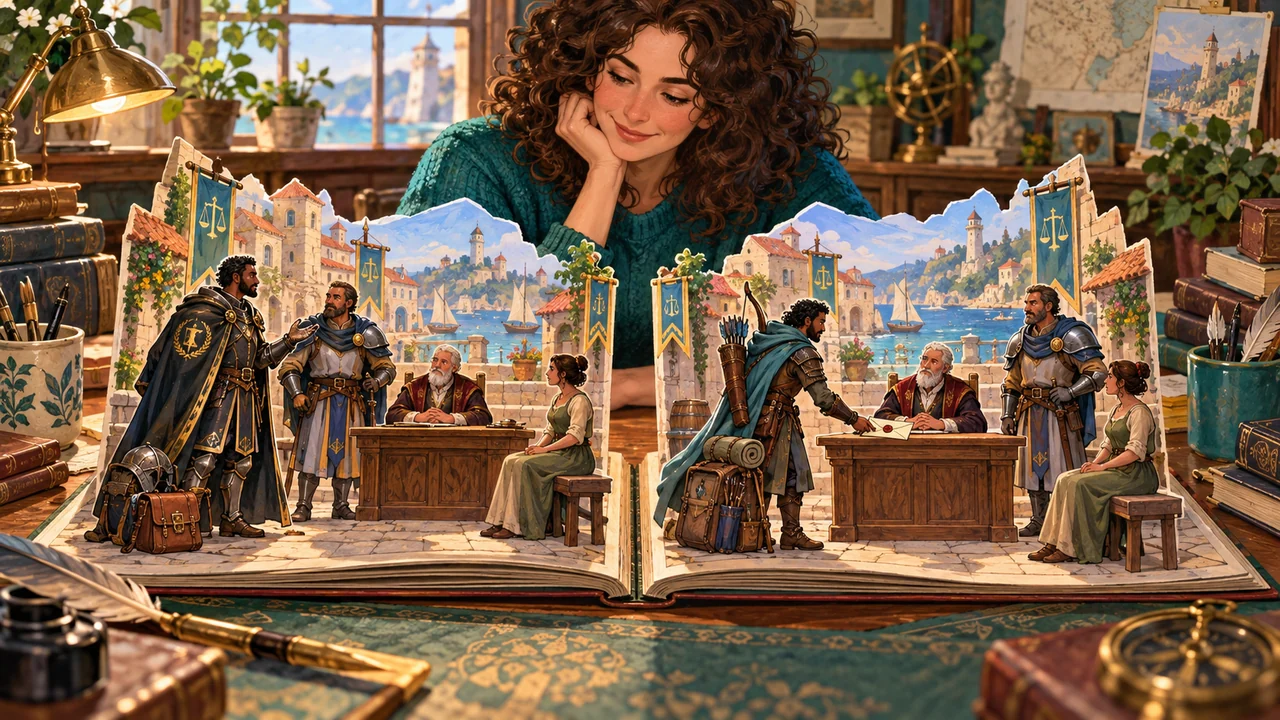
If both paths reach the same trial, do the choices still matter?
Kane arrives in Grayharbor.
In the square, a witness named Ilo is facing a public trial. You want Kane to secure his release and make this trial the starting point of the next investigation.
But Kane has two different pasts.
In one path, he acquires the black iron relic, undergoes a trial you have devised, becomes a Black Knight, and joins the Black Oath Legion.
In the other, he acquires the runic bow, receives training, becomes an Arcane Archer, and joins the Arcane Society.
Both paths need to pass through Grayharbor.
You do not want to design another city, another accused witness, and an entirely different trial for each one.
Yet if both versions free Ilo through the same dialogue, receive the same help, and enter the same next chapter, what remains of the earlier choices?
This is a familiar dilemma in interactive fiction design.
Let every branch develop independently, and the amount of writing soon grows beyond what you can finish. Bring the branches back to the same scene, and you risk readers realizing that their choices no longer seem to matter.
But convergence itself may not be the problem.
The problem may be that the story erases the past when the paths rejoin.
Both paths can reach the same trial.
That does not mean the person arriving has to be the same Kane.
Share the scene, not necessarily the conditions each character brings
The square can be the same.
So can the charges against Ilo, the judge, the guards, and the immediate crisis.
What needs to differ is what Kane brings into the scene.
In the Black Knight path, you have given him a Legion badge and established a relationship with the guard captain.
In the Arcane Archer path, you have given him a letter that could help defend Ilo, but he has not yet met the captain.
| At the same trial | Black Knight path | Arcane Archer path |
|---|---|---|
| Kane’s identity | You have confirmed him as a Black Knight | You have confirmed him as an Arcane Archer |
| Faction membership | He has joined the Black Oath Legion | He has joined the Arcane Society |
| Items he carries | The Legion badge | The runic bow and a letter containing evidence |
| Relationship with the guard captain | Established in earlier scenes | Not yet established in this version |
| Possible negotiation | You can have him ask the Legion to vouch for Ilo | You can have him present the evidence |
| Possible cost of securing Ilo’s release | You can have him accept the Legion’s terms | You can have the judge keep the letter |
These conditions do not come automatically with a class name.
Becoming a Black Knight does not automatically make Kane a Legion member, give him a badge, or introduce him to the guard captain.
Becoming an Arcane Archer does not automatically give him evidence, either.
Each is an event you have confirmed within that particular timeline.
The negotiation options in the table are also possibilities you can develop, not solutions the causality engine has chosen for the character.
Branches create different possibilities.
They do not have to replace one fixed answer with another.
Different dialogue helps, but the difference cannot end there
In the Black Knight path, the guard captain might say:
“You again. What does the Legion want to interfere with this time?”
In the Arcane Archer path, he might say:
“Stop. What are you doing here?”
These differences are useful. They let readers feel that the story remembers what came before.
But if both lines are followed by immediate permission to pass, identical assistance, and no lasting consequences, the difference may be little more than cosmetic.
Whether two people know each other can affect more than how they greet one another.
It may change who is willing to hear Kane out, who asks for something in return, and who has reason to suspect him.
Possessing an item can affect more than a description.
Once Kane hands over the letter, it cannot remain in his pack in the next scene without an explanation.
A promise should not disappear when the trial ends, either.
The Legion may agree to vouch for Ilo because Kane promises to help with something later. That promise does not have to appear in the very next chapter.
But it still exists.
Readers do not need to see a complete state table every time.
You need to know that sharing a scene has not erased the differences.
Sharing a scene does not mean merging two complete worlds
“Branch convergence” can sound as though the earlier versions must be combined into a single version.
It helps to separate two things.
One is narrative structure: both paths reach Grayharbor and encounter Ilo’s trial.
The other is world data: the Black Knight and Arcane Archer timelines still retain their own character identities, items, factions, and events.
You can use the same trial concept in two complete story versions, adapting the scene to the state of each world at that point.
Kane does not need to acquire all the resources from both paths.
Nor do the Legion’s guarantee and the defense letter both need to become things that have already happened.
What the versions share is the situation the scene addresses.
They do not share every fact established in their separate histories.
For interactive fiction writers, this distinction matters.
You can keep the number of scenes manageable while allowing each history to produce different reactions within them.
Convergence does not have to mean a reset.
It can simply mean that people with different pasts encounter the same problem.
In InkWeave, write the negotiation while seeing who Kane is at that moment
You do not need to map every branch of the entire work before writing this trial.
Start with Kane, Ilo, the guard captain, the square, and the items the scene actually uses.
When you reach the Legion’s involvement, add the faction and any conditions you need to preserve.
The world can grow as the story does.
In InkWeave, when an established character, location, or item appears in the manuscript, the scene-aware view and Inspector can show its relevant state at the cursor’s position in the story.
As you write about Kane, you can check his identity, attributes, and faction membership at that moment in the Inspector.
As you write about the square, you can check the recorded locations and the people present.
As you write about the letter, you can see who currently holds it.
The information is beside the prose.
You can keep writing the guard’s hesitation, Kane’s request, and the moment Ilo lifts his head in the crowd. You do not have to leave the scene after every sentence to consult several separate lists.
When Kane’s name appears near the guard captain’s, InkWeave can offer an interaction prompt so you can decide whether to establish a relationship or address a location mismatch.
But two names appearing near each other does not mean the characters have spoken.
If Kane is merely remembering the captain from a distance, you can skip the event prompt.
When Kane hands the letter to the judge, you can confirm the transfer right where you are writing.
The item’s holder changes through the confirmed event. You do not need to maintain another note that always lists its latest owner.
You remain responsible for the negotiation.
InkWeave brings the world you have established into view, giving the adventure you are writing a visible response.
Both paths can free Ilo and still leave different costs
You decide that both paths succeed in freeing Ilo.
That does not necessarily make the earlier choices meaningless.
What matters is what remains afterward.
In the Black Knight path, the Legion vouches for Ilo, but Kane promises to escort a messenger later.
In the Arcane Archer path, the judge accepts the evidence and keeps the letter as part of the case record.
Ilo is released in both.
But the next adventure already begins from different circumstances.
| After Ilo is freed | Black Knight path | Arcane Archer path |
|---|---|---|
| Ilo leaves the trial square | You record his move to the agreed meeting place | You likewise record where he actually goes |
| Kane’s items | He keeps the badge unless you record another transfer | The judge holds the letter; Kane no longer has it |
| Confirmed story conditions | The Legion has vouched for Ilo; the escort promise remains unfulfilled | The evidence has been submitted; Ilo has been released |
| Possible later developments | The Legion may ask Kane to fulfill his promise | You may write new reactions as the evidence becomes public |
If the promise, submission of evidence, or release needs to be tracked, you can define the corresponding flags.
Character movements and item transfers remain their own events.
None of these changes automatically becomes true just because you write “Ilo was saved.”
This approach also helps you manage the amount of writing.
The next chapter can still use the same waystation. In both versions, Kane and Ilo can rest there and exchange information.
But when the Legion’s messenger arrives, the Black Knight path may need to address Kane’s earlier promise.
The Arcane Archer path should not acquire that obligation out of nowhere.
One scene can carry forward different histories.
A shared outcome does not have to cancel the costs each path paid to reach it.
The causality engine checks prerequisites; it does not choose a path
A common mistake in shared scenes is to reuse material from another path without checking its prerequisites.
In the Arcane Archer path, Kane can hand the letter to the judge.
You move that negotiation into the Black Knight path but never give him the letter.
If you record the handover as an item transfer, it depends on a source this timeline has not provided.
Or a later scene requires the condition “Evidence submitted.”
The Black Knight path has only established the Legion’s guarantee. Reusing the same requirement does not make the missing condition true.
InkWeave’s custom-built causality engine can use the events recorded in the current timeline to verify whether those items and conditions support what happens next.
This is not AI auditing.
It does not give AI two passages and ask it to guess what looks implausible.
The causality engine starts from the initial state and events you have explicitly established. It derives the world in order, then checks the conditions required by later events.
The same model, rules, and event sequence produce consistent results.
The mathematical guarantee applies to that defined world model. It is not a claim to understand every sentence or interpret every literary meaning.
If you want a later scene to check “Evidence submitted,” you need to define that state and record it when the submission happens.
Handing over an item does not automatically set every possible informational or legal condition associated with it.
Nor does the causality engine decide that the guards should step aside because Kane is a Black Knight.
It does not automatically interpret class abilities, generate choices for readers, or execute story branches for them.
The workflow described here is for writing interactive fiction, managing world state, and validating causality.
It is not a workflow for exporting or running a playable interactive story in InkWeave.
You still decide which choices exist and how they change the story.
The causality engine helps those confirmed changes continue to matter.
Keep complete versions, then adapt the shared scene to each history
If you are drafting two paths that need to develop independently, you can preserve complete story versions.
The Black Knight version retains Kane’s Legion membership, badge, character relationships, and the event where the Legion vouches for Ilo.
The Arcane Archer version retains his Society membership, runic bow, letter, and submission of evidence.
The trial can use the same underlying concept.
Each version still draws its answers from its own history.
Want different paths to share the same trial while keeping their own identities, items, and consequences?
Follow the What If Branching and Multiverse Story Tutorial to save and switch between complete story versions, then return to each timeline to adapt the shared scene.
This workflow uses an external versioning tool. It is not built-in, one-click branching or automatic convergence in InkWeave.
Before saving or switching versions through that workflow, completely close InkWeave and follow the tutorial. This prevents autosave from writing content into the wrong version.
The external version-saving workflow works with the free edition. The scene awareness, causal state derivation, and automatic validation described in this article are InkWeave Pro features.
The causality engine validates the timeline currently open. It does not treat events from other, unopened versions as things that have happened here.
You do not need a complete timeline for every variation in dialogue, either.
The versions worth preserving independently are the ones you choose to keep developing, with their own distinct world states.
Brief differences in how a scene plays out can remain part of your writing plan.
Identities, items, relationships, and conditions that keep affecting later scenes are what need lasting records.
Convergence does not mean giving every choice the same answer
Not every choice in interactive fiction has to change the entire ending.
Some choices change who travels with the protagonist.
Some change who is willing to trust him.
Some give him a resource.
Others leave him with a promise he never would have made.
These differences can remain alive in shared scenes.
At the same trial square, Kane may be a recognized Legion member or a stranger carrying evidence.
After freeing the same witness, he may owe an escort or no longer have the original letter in his possession.
Even as both versions enter the next chapter, the character can still stand within different relationships and conditions.
You do not need to rewrite the entire world for every path.
You need to know what can be shared and which parts of the past cannot be left out.
As you continue writing in InkWeave, character identities, item locations, and faction states can appear according to your position in the story. The differences do not all have to rest in your memory.
The world does not write the next scene for you.
But it can bring the adventure you have already written back beside the sentence you are working on.
Branches do not have to lead to different places forever.
The people who arrive at the same place should bring their own history with them.
Then convergence is not where choices stop mattering.
It is where different choices begin to face the same problem.