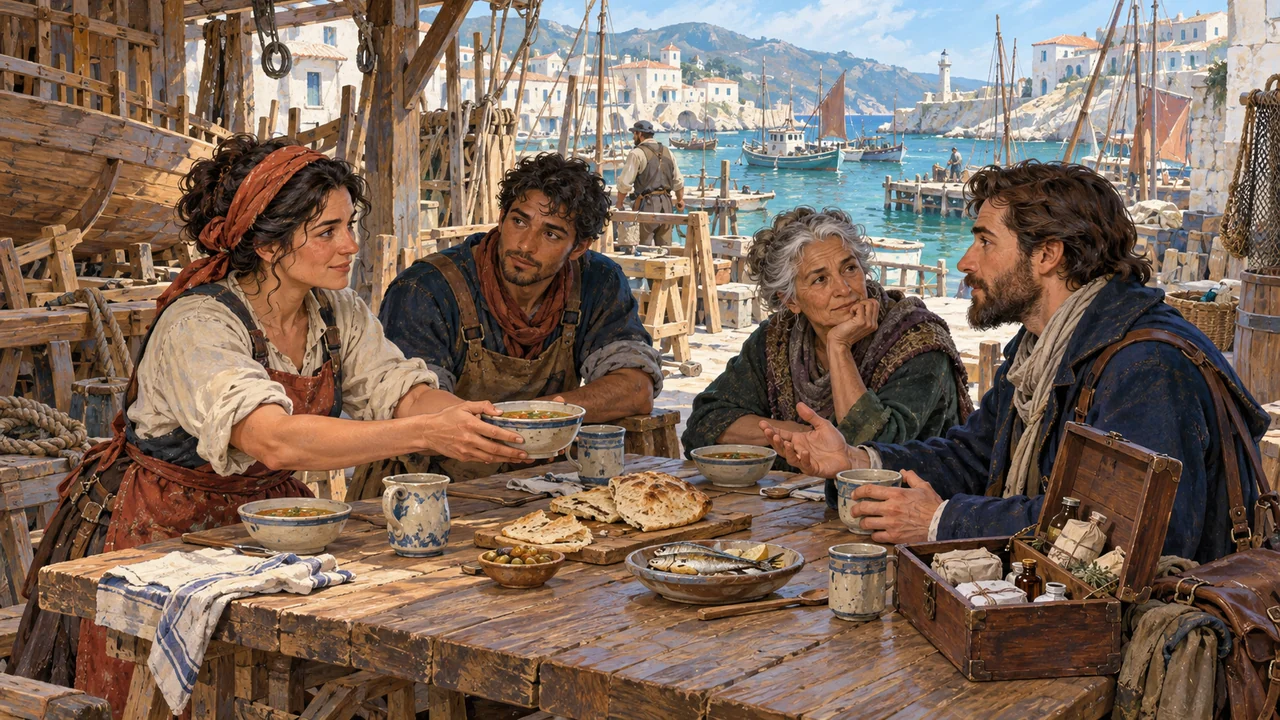
You’ve given a port its own fish soup, festival clothes, and things people must never say at the dinner table.
Yet when a stranger actually sits down to eat, you may still find yourself unsure how to write the scene.
Is the host simply making the visitor welcome, or inviting him into a group? When someone vouches for him, is he also accepting expectations that have never been spoken aloud? If he later decides to leave, who will consider that a betrayal, and who will believe he always had the right to choose?
These questions get closer to how culture affects characters than the name of a dish ever could.
To create a fictional culture, start with the practical problems people share. Work out how they eat, welcome guests, divide responsibilities, and understand one another. Then let different people make different choices about those customs.
You don’t need an encyclopedia of an entire civilization before you begin. Start with a household, a workshop, or a neighborhood. Let characters live there, and the culture can take shape through their lives.
Contents
- Start with the practical problems people share
- Make food and hospitality part of daily life
- Design etiquette and taboos while leaving room to refuse
- Let people within the same culture disagree
- Write a negotiation that changes the story
- Fictional culture worksheet and scene checklist
- Fictional culture worldbuilding FAQ
- Track relationships, groups, and items in InkWeave
Start with the practical problems people share
Culture isn’t just a collection of clothes, languages, and festivals. It also lives in things people do repeatedly and assumptions they think everyone should understand.
Who looks after the children of someone working away from home? Can a stranger borrow tools? Does accepting help mean owing something in return? When a friend’s request conflicts with your own plans, how do you say no without seeming heartless?
You don’t need to answer everything at once. Choose a few questions your characters will actually face.
For this example, we’ll use the fictional port of Tidebay.
Winter weather makes sailing unpredictable here. People at sea can’t always return when expected. Those who remain need ways to care for families, share repairs, and keep food in reserve.
In this version of the setting, some residents have long relied on friends and relatives. Others join the Harbor Mutual Aid Society to arrange more regular cooperation.
That doesn’t mean living in a port automatically makes people close-knit. The same circumstances could lead them to hire help, rely on family, or insist that every household fend for itself. Your culture grows out of arrangements people have made. Geography doesn’t write everyone’s personality for them.
| Question to explore | One possible arrangement in Tidebay | What to ask next |
|---|---|---|
| Who keeps a household going when family members are at sea? | Friends and relatives take turns helping, with some work coordinated by the society. | Who contributes most often? Are they free to refuse? |
| How do people prepare for delayed voyages? | Households keep preserved food, and people share meals at the workshop. | Who provides ingredients, cooks, and clears up afterward? |
| How does a stranger earn trust? | Someone introduces them; people work together before entrusting them with important belongings. | Is it harder to find opportunities without someone to introduce you? |
| How are responsibilities agreed on? | Established members rely on spoken agreements; newcomers want clear end dates. | Who sees an explicit agreement as distrustful? Who thinks leaving things unsaid is unfair? |
| What happens when an old arrangement no longer works? | Some renegotiate the duty schedule; others begin paying for certain services. | Is someone changing a custom undermining tradition or addressing something it failed to provide? |
This table does more than list the port’s customs. It begins to show whom those customs reassure and whom they put under pressure.
A culture can offer security while repeatedly placing the burden on the same people. Both can be true.
Worldbuilding note: Culture is not an inherited personality or an inevitable result of geography
People of the same fantasy ancestry can live in different cultures, and people of different ancestries can share customs. The same environment need not produce the same institutions. A shared habit doesn’t mean universal agreement, either. Start with specific households, communities, and characters, then decide which understandings are more widely shared.
Make food and hospitality part of daily life
Food can be one of the most accessible ways to introduce readers to a culture. But a list of dishes isn’t a life.
Rather than simply saying that people in Tidebay eat fish soup, flatbread, and preserved vegetables, let the characters sit down to a meal.
Mira, a boatbuilder, invites Ivan, a visiting apothecary, to eat at the workshop. Instead of seating him at a separate table for guests, she makes room among the people she works with. Someone tops up the soup while others discuss tomorrow’s boat repairs.
Ivan offers to pay for his meal. Mira says there is no need, but Dane, a young dockworker, adds, “You don’t owe us for the soup. Just don’t forget that all this takes somebody’s time.”
One remark makes the shared meal more than a decorative sign of hospitality.
Dane might be working two jobs, with little time for unpaid duties. He likes this table. He also knows that some people always get to eat later than others.
| Look beyond the menu | What else can you ask? | What the scene might reveal |
|---|---|---|
| Where the food comes from | Do households bring it, prepare it together, or pay for it? | A resident can contribute ingredients but has no time to stay and help. |
| Who eats with whom | Do guests, apprentices, hired workers, and family members sit together? | Ivan is invited to the table but isn’t sure whether he is a guest or a fellow worker. |
| Who serves the food | Who is served first, who decides portions, and who gets special consideration? | A familiar face has soup set aside without asking; a stranger first has to be noticed. |
| What people can discuss | Can work, money, family matters, and refusals be discussed openly? | One person thinks clear payment terms are practical; another finds public accounting hurtful. |
| Who finishes the work | Who washes up and clears the table? Whose labor goes unnoticed? | Younger people leave first, and those who remain hear “everyone helped” rather differently. |
You don’t need to explain every answer to the reader at once. Choose one or two that matter to the characters in this scene, and put them into action and dialogue.
Ivan reaching to clear the bowls can say more than a narrator declaring that he wants to fit in. But he might simply be expressing thanks. It doesn’t mean he has agreed to any lasting responsibility.
Use the same approach for clothing, forms of address, and domestic spaces. Don’t just name them. Ask when people use them, who is entitled to use them, and what happens when someone does otherwise.
Design etiquette and taboos while leaving room to refuse
Customs often depend less on an object itself than on how people interpret an action.
Handing someone a tool can mean lending it, giving it away, asking them to keep it safe, or assigning them a job. Sharing a meal can express welcome without making two people friends.
When designing a custom, distinguish three things:
- What a character actually does.
- How other people interpret it.
- What the person involved understands and agrees to.
Mira is willing to introduce Ivan to the mutual aid society. She believes vouching for him puts her own reputation on the line. Ivan thinks she is simply telling people they can trust his medical expertise.
Both may care about keeping promises without realizing they are discussing different promises.
| Action | One possible interpretation | What still needs to be made clear |
|---|---|---|
| Inviting a visitor to share a meal | Bringing someone closer to your everyday life. | Is this just a meal, or also an invitation to work together? |
| Vouching for a newcomer | Introducing someone on the strength of your own reputation. | Are you vouching for their skills, their character, or a particular piece of work? |
| Handing over a medicine chest | Giving someone the means to do the work. | Is it a loan or a gift? How long will the work last? Who receives the chest when they leave? |
| Announcing plans to leave | Possibly refusing to continue a responsibility. | What was the original end date? What was agreed, and what did other people merely expect? |
You can design taboos in the same way.
Some society members might consider it disrespectful to leave borrowed tools at the workshop and depart without telling anyone. Perhaps this custom developed after people couldn’t find tools or arrange for someone else to take over. It needs more of a reason than “that’s just how the locals do things.”
But formally returning a tool, giving notice before leaving, and deliberately throwing the tool onto a table are different actions. A character can refuse an expectation without the author making that refusal inherently rude.
Writing note: An assumed expectation is not an agreement
Cultural differences can explain how a misunderstanding develops. They don’t automatically justify what either side demands. Who should explain the rules, who can refuse, and what refusal costs are all questions the story can explore.
Let people within the same culture disagree
If every resident supports Mira and every outsider supports Ivan, cultural conflict can become a debate between two neatly divided camps.
Let individual experience disrupt that neatness.
Mira once relied on neighbors when a family member had not yet returned from sea. She knows mutual aid is more than a comforting slogan. She also worries about people accepting care and disappearing when it is their turn to contribute.
Tasha, the older woman who looks after the society’s supplies, favors clear end dates. She has seen too many people become unable to manage their own lives because they were embarrassed to say no.
Dane wants to reconsider payment, not because he dislikes the port, but because he cannot keep proving his commitment through hours he cannot afford to give away.
Ivan has ties elsewhere, too. He has already promised to return to an upriver village to care for his mentor. Staying could mean letting someone else down.
| Character | What matters to them | What they want to keep or change |
|---|---|---|
| Mira | Mutual aid needs willing contributors, and introductions depend on trust. | Keep personal recommendations and cooperation, but make sure people don’t simply disappear. |
| Tasha | Caring for others should not depend on obligations people cannot refuse. | Keep mutual aid while making end dates and handovers explicit. |
| Dane | People contributing their time still have to support themselves. | Pay for some work instead of relying entirely on personal favors. |
| Ivan | He wants to help, but also keep promises made elsewhere. | Be clear about what he can offer, rather than accept unlimited responsibility out of gratitude. |
These disagreements don’t have to follow age lines. Older people can support change; younger people can value old customs. Characters need experiences of their own, not a generational position to represent.
One person also belongs to several groups at once. Mira is a boatbuilder, a family member, and a society member. The bluntness she is used to at the workshop may not be how she speaks to older relatives at home.
A city doesn’t need to speak with one voice. Households, neighborhoods, occupations, and experiences of moving there can all produce different versions of shared customs.
Write a negotiation that changes the story
Now put those decisions into a complete story.
Mira introduces Ivan to the Harbor Mutual Aid Society. He joins as an apothecary, agreeing to help for a short time. Tasha gives him a medicine chest to use on visits to nearby households.
It isn’t that they explained nothing. They discussed the work, and he joined. What they missed was the word everyone thought they understood: short-term.
Mira believes he will at least stay until someone can take over the winter care. Ivan assumes the return journey he mentioned earlier is still understood.
A few weeks later, he announces over a shared meal that he intends to leave at the end of the month. Only then does Mira realize they have been working under different expectations.
“I put my name behind yours,” she says. “I didn’t just find you a seat at the table.”
Ivan might ask, “Then why didn’t you tell me what you wanted me to agree to?”
The story doesn’t need to decide immediately who is the better person. First, let those words affect them.
Mira begins to doubt whether Ivan is reliable. Ivan is still grateful to her, but no longer willing to treat vague courtesies as settled arrangements. Other members share their own experiences, so this becomes more than residents blaming a newcomer.
Then make the negotiation specific.
Ivan explains why he must return and sets out the help he can provide before the month ends. Tasha rearranges the duties for after his departure. Dane says that if he is to take on more work, he needs appropriate pay. Mira explains that what frightens her is work being left without a handover, not the possibility of Ivan ever leaving.
They reach an agreement: Ivan will complete the visits already arranged before the end of the month, review the households still needing cover with Tasha, and return the medicine chest. He will leave his role in the society without necessarily cutting ties with Mira.
This outcome doesn’t have to prove Tidebay’s customs entirely right or wrong. It lets the characters discover expectations that need to be spoken aloud and reconsidered.
| Problem before the discussion | What the characters clarify | What the later story must remember |
|---|---|---|
| They understand short-term differently. | Ivan will help until the end of the month; the society will make arrangements after that. | Later scenes cannot treat him as having promised to stay all winter. |
| Mira fears her recommendation has been taken for granted. | She needs a reliable handover, not an indefinite commitment. | They can work together again without the misunderstanding instantly disappearing. |
| Extra work has been allocated through personal favors. | Some duties need clear payment or a revised schedule. | Whoever takes over has conditions of their own, rather than existing to fill a gap whenever needed. |
| Ivan has borrowed the medicine chest. | He will return it to Tasha before leaving. | After returning it, he cannot keep producing the same chest somewhere else. |
The negotiation can fail, too. If Mira continues to see refusal as betrayal, Ivan might return the chest and leave with their relationship damaged.
Whatever outcome you choose, let later scenes acknowledge it. Culture doesn’t just make a setting look different. It changes whom people will work with, what help they can obtain, and what they take with them when they leave.
Fictional culture worksheet and scene checklist
You can begin by collecting your answers in a short worksheet. Not every custom needs centuries of invented history. Start with what the story will use.
| Element | A worked answer for Tidebay |
|---|---|
| A shared practical problem | Unpredictable voyages mean someone ashore must keep households and work going. |
| Arrangements that have developed | Friends and relatives help one another; residents can also choose to join the Harbor Mutual Aid Society. |
| Visible everyday customs | Shared workshop meals, personal introductions, borrowed tools, and rotating duties. |
| How food connects to responsibility | Sharing a meal feels natural, but ingredients, preparation, and clearing up still cost someone time or resources. |
| How trust develops | Working together, keeping promises, and gradually getting to know people through others. |
| An expectation often left unspoken | Someone who receives help should be willing to contribute later. |
| A possible taboo | Some consider leaving borrowed tools without notice disrespectful to the person who introduced you. |
| Internal disagreements | Some value personal obligations; others want clear end dates or paid work. |
| Difficulties for newcomers | Being welcomed doesn’t mean understanding every responsibility. Joining may be harder without an introduction. |
| How customs can change | Turn vague expectations into end dates, payment, and handover arrangements both sides can accept. |
| Lasting story consequences | Trust changes, a role ends, work is redistributed, and the medicine chest is returned. |
After writing a scene involving cultural differences, ask:
- If you removed the invented names for foods, clothes, and places, would culture still affect the characters’ choices?
- Do customs appear in action and dialogue, rather than only in narration?
- Can characters understand the same custom while disagreeing about how to practice it?
- Have you distinguished accepting an invitation, accepting resources, and making a commitment?
- Do people who struggle to speak up, lack introductions, or have fewer resources get a position of their own?
- Can the conflict lead to negotiation or refusal, rather than only obedience or punishment?
- Is at least one relationship, arrangement, or choice genuinely different by the end?
If the answers are still vague, you don’t need ten more festivals yet. Return to the scene. Let one person make a specific request, and give another a reason to agree, hesitate, or refuse.
Readers will often understand a culture through these exchanges, not through the volume of your setting notes.
Fictional culture worldbuilding FAQ
Does a culture have to correspond to one fantasy ancestry or country?
No. You can start with a locality, a household, an occupational community, or a shared experience. A country can contain different ways of life, while people from different backgrounds can develop common habits through years of working together. Decide who shares which understandings. National borders, ancestry, and cultural boundaries don’t have to coincide.
Do I need a complete language and every festival first?
No. Start with the forms of address, ways of refusing, significant occasions, and everyday arrangements your story needs. Expand when the plot calls for a misunderstood word, a particular festival, or encounters with customs elsewhere. Your notes should support the story, not keep you from starting it.
How do I stop every character from becoming a spokesperson for their culture?
Give them specific experiences and other commitments. Two people who value mutual aid may make different choices about unpaid duties if one has a steady income and the other is struggling to support a family. Don’t ask only, “What does this culture think?” Ask, “What can this person afford to take on in these circumstances?”
Does cultural conflict require someone to be rude or wrong?
No. Both sides may mean well while understanding time, personal space, or responsibility differently. Differences can also produce curiosity, learning, and new practices. If the scene involves unequal power, let readers see who sets the rules and who pays the price of refusing. “Respect the culture” cannot settle that question by itself.
You now have ways to design daily customs, write disagreements, and let characters negotiate an outcome.
Only then comes the question of keeping track: as the story continues, who still trusts whom? Who remains in the society? Where is the medicine chest? Which commitments have both sides actually confirmed?
Track relationships, groups, and items in InkWeave
You don’t have to build all of Tidebay before writing in InkWeave. Start with Mira, Ivan, the workshop, and the medicine chest. Add Tasha and the society when the story needs them, and you can begin recording these exchanges.
You still write the culture’s background and meaning. What needs ongoing tracking is the choices the characters actually make.
Start with an introduction and a decision to join
When Mira and Ivan first talk, you can confirm whether a relationship is established. Later cooperation can change that relationship at the point where it happens.
For example, you can define a relationship type called Trust, with values and stage labels that suit your story. Mira’s trust in Ivan and Ivan’s trust in Mira can be recorded separately. Sharing a meal doesn’t have to make both people equally close.
This doesn’t mean scoring every line of dialogue. Record a change when a collaboration, misunderstanding, or negotiation will continue to affect the story.
Next, use the Factions feature to create the Harbor Mutual Aid Society and arrange its members, titles, and reporting relationships. Tasha can coordinate the work, Ivan can serve as the society’s apothecary and report to her, and Mira can have her own place in the group.
A faction here doesn’t have to be a political side. It can represent a guild, a working group, or a family. But the society isn’t the whole port’s culture. People outside it may share similar customs.
Ivan’s professional identity as an apothecary is also separate from his position in the society. He can finish this particular role and still be an apothecary.
Record the medicine chest’s transfer separately from social expectations
When Tasha hands the chest to Ivan, record an item transfer. You can then check who holds it at that point and look back through its transfer history.
You can establish in the story and supporting notes that this is a loan, not a gift. The engine doesn’t interpret ownership, loan terms, or social obligations merely because the holder changes.
If returning it at the end of the month is an agreement a later scene needs to check, explicitly record the conditions both parties have confirmed.
Likewise, joining the society, receiving the chest, and promising to stay until winter ends are three different things. The first two happening doesn’t automatically establish the third.
Keep the outcomes connected without treating them as one event
When Mira and Ivan settle on an end date, you can record how the conversation changes their relationship. At his departure, confirm the chest’s return and what happens to his position or membership.
These developments intersect without having to become the same outcome.
| Cursor position in the story | Relationships and organization | Medicine chest |
|---|---|---|
| Before the introduction and decision to join | Ivan doesn’t yet hold his later position. Relationships reflect only the exchanges already recorded. | Still held by Tasha. |
| After joining and taking on the work | The cooperation and organizational position you’ve confirmed take effect. | Transferred to Ivan. |
| After the disagreement about leaving | Relationships reflect the changes you’ve recorded. Ivan isn’t treated as having left before a departure is recorded. | Still held by Ivan unless another transfer occurs. |
| After the agreement, return, and departure | Ivan no longer holds the role or membership you’ve ended. His relationship with Mira follows its own recorded events. | Returned to Tasha, not simultaneously kept by Ivan. |
Leaving the society therefore doesn’t automatically delete his relationship with Mira. Returning the chest doesn’t erase the work they did together.
As you write, the scene display and Inspector show character information and belongings for the cursor’s position. If you’ve added images, the characters, workshop, and chest can appear too. Open the relationship map or organization chart when you need to check the people and roles at that point.
Move the cursor back to the shared meal, and you don’t see Ivan as he is at the end, after leaving the port. As you pass the joining, transfer, negotiation, and departure events, the relevant states change in sequence.
This feedback can stay alongside your writing. You don’t need to interrupt every sentence to organize notes. When characters, items, or locations appear in a supported interaction, the event wizard can show their current state and let you confirm whether a transfer, movement, or relationship change actually happens.
You are still writing people’s lives. You just don’t have to maintain every latest answer alone across separate sets of notes.
Recheck later scenes when you revise an earlier cause
Suppose you go back and decide Tasha never lent Ivan the chest, then remove the corresponding transfer event.
The later return now lacks a source. Ivan cannot hand Tasha a chest he never held in this history. Causal validation can flag the possession and transfer prerequisites, leaving you to decide whether to add another acquisition or rewrite the handover.
If you change only the prose without adjusting the event you created, the recorded transfer still exists. When revising, keep the narration and explicit events aligned. The engine isn’t guessing your decision from a rewritten sentence.
For an unfinished handover, you can also place requirements in the future departure scene. For example, explicitly create flags for “The replacement has agreed” and “Outstanding care has been arranged,” then check them with a REQ requirement anchor. While the earlier negotiations remain unfinished, the project-wide validation dashboard can keep those tasks in view.
REQ checks the flags you have explicitly defined. It doesn’t infer that every promise has been settled from a title, the receipt of a chest, or someone saying thank you.
Practical note: The engine tracks confirmed outcomes, not a character’s understanding of culture
InkWeave’s Causality Engine is developed in-house. It uses deterministic calculations based on explicit events, quantities, relationships, and conditions, not AI reading the manuscript to judge emotions or decide which culture is right. You choose who agrees to what and how relationships change. The engine carries those recorded consequences forward through the story’s timeline.
To try a simple exchange, follow the Getting Started guide. Create characters, a location, and an item, then add relationships and groups as you need them. For download and plan details, see InkWeave Pricing.
Culture isn’t only what characters eat or wear.
It also lives in what one person thinks they are accepting when another offers help, and whether they can come to understand each other again after someone says no.
First, make those exchanges into a story worth reading. Then let the story remember how people lived, worked together, and changed.