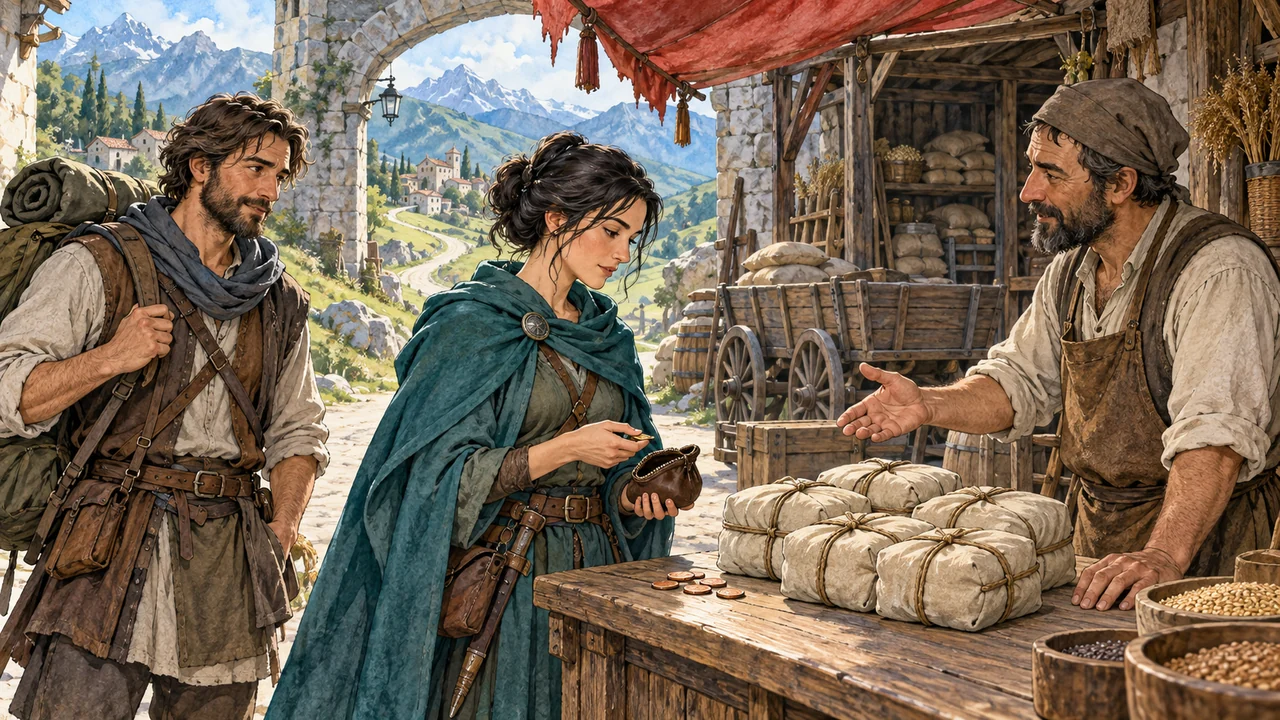
A character enters a market, hears the price of a ration, and pauses with a hand on her purse.
The writer may pause here, too.
How much should a ration cost? How many nights will a silver coin pay for? If ordinary people earn only a few coppers a day, why can an adventurer casually produce a bag of gold?
You don’t need a complete economic model to begin answering those questions.
Start designing fantasy currency and prices with a few everyday reference points: how people use money, what their labor can buy, and which other choices a purchase makes them give up.
You don’t have to price every item in every shop. Make the few prices your story uses fit together, and your characters can begin living in the world.
Writing note: You don’t have to account for every meal
Readers generally care more about characters and plot than a missing coin in the arithmetic. Prices can simply make daily life feel real. Closer tracking becomes useful when money or supplies affect where someone can go, whom they can help, or what they must give up.
Contents
- Decide which prices need to be explicit
- Currency design is more than exchange rates
- Anchor prices in wages and everyday costs
- Allow the same item to have different prices
- Show how money changes choices on one journey
- Fantasy currency and pricing worksheet
- Fantasy currency and pricing FAQ
- Bring key trades and supplies into view with InkWeave
Decide which prices need to be explicit
Numbers can serve different purposes in a story. They don’t all need the same precision.
A character finishing a bowl of soup and leaving a few coppers may be a passing detail. An expensive inn sending her back into the street begins to reveal her circumstances. When the last of her travel money determines whether she can take a companion out of town, the amount becomes a condition for what happens next.
| What the price does in the story | How much detail might you give? | Does it need ongoing tracking? |
|---|---|---|
| Makes markets and everyday life feel tangible. | Describe something as cheap, expensive, or roughly priced. | Usually it can stay in the prose. |
| Helps readers understand a character’s burden. | Compare it with a day’s wages, several nights’ lodging, or accumulated savings. | A few reference points may be enough; you needn’t track every purchase. |
| Determines whether a later event can happen. | Establish available money, necessary spending, and supplies. | It is worth recording if later scenes depend on that limit. |
This isn’t a request to turn your novel into a ledger.
It helps you distinguish background numbers from numbers that are shaping a character’s choices.
If a difference of one coin changes nothing, you don’t need to stop the story for it. If a purchase leaves a rescue party without transport, or forces someone to ask an enemy for help, it deserves another look.
Currency design is more than exchange rates
Knowing how many copper coins equal one silver coin makes calculations easier. It doesn’t yet tell readers how money fits into people’s lives.
Decide what people use for everyday purchases first. Then consider whether the story needs larger denominations.
In this fictional region, people pay everyday expenses in copper coins. Locally, one silver coin is valued at 20 coppers. Whether gold coins exist, or whether distant cities accept the same money, can wait until the plot needs an answer.
You can also choose a few rules that will actually appear in the story.
| Currency question | A possible decision | How it might enter the story |
|---|---|---|
| What do people use for everyday payments? | Copper for small purchases, silver for larger ones. | Characters don’t have to produce a whole bag of small coins every time. |
| Who accepts this money? | Local merchants accept it; distant traders may require an exchange or negotiate a different price. | Arriving with money doesn’t necessarily mean being able to buy something immediately. |
| What makes people trust it? | A royal court, a city, a trading guild, or an institution of your own design. | Changes in political power or trading networks may affect what sellers will accept. |
| What does buying on credit mean? | Someone will accept payment later, subject to terms and a deadline. | A promise to pay is not money already handed over. |
Not every bowl of soup needs a discussion of minting. Bring change, exchange, or credit into a scene when it matters there.
Nor does every region need the same system. Some communities may place greater value on a familiar person’s word. Some trades may require goods rather than coins. Value can also come from resources or rules particular to your world.
What matters is that when a character uses money, you know why it works in that situation.
Anchor prices in wages and everyday costs
Choose a few recurring reference points: a meal, a day’s food, basic lodging, and the pay for an ordinary kind of work.
Building around these is much easier than pricing hundreds of goods first.
Example note: All the figures below are invented
These prices demonstrate an internal scale for a fictional setting. They are not historical prices, real-world exchange rates, or rules from a game. Change the figures or use a different currency entirely.
| Reference point | Price or pay in this example | What it helps you judge |
|---|---|---|
| A day’s pay for one kind of ordinary laboring job | 40 coppers | A reference for income and spending, not a universal wage for every job. |
| A simple hot meal | 4 coppers | A day’s pay buys about ten meals of this kind. |
| A basic bed for one person for one night | 8 coppers | Lodging is not a trivial expense for an ordinary traveler. |
| One person’s daily travel ration | Usually 8 coppers | A rough basis for planning food and costs for this journey. |
This table doesn’t need to prove that the world is perfectly balanced. It only needs to make a few important prices comparable.
For example, a day laborer earning 40 coppers spends 20 on three of those hot meals and one night’s lodging. What remains may still have to support family, tools, and other expenses.
If repairing an essential tool costs 200 coppers, that is five days’ gross pay. It doesn’t mean the worker can necessarily save the money in five days.
Likewise, don’t simply multiply the daily wage by the number of days in a month and assume that is what the character earns. Whether work is available every day, and whether illness or time between jobs brings any income, can change their circumstances.
You don’t have to turn all these details into calculations. They may simply help you write why someone accepts dangerous work for what seems a modest reward.
Adventure pay needs a separate look, too.
A well-paid job doesn’t make a character immediately wealthy. Supplies, transport, equipment, and the wait for final payment may all tie up resources they already have. What matters is what they have left after those costs, not just the figure on the job notice.
Allow the same item to have different prices
Having reference prices doesn’t mean everything must cost the same everywhere.
The same ration can have one price in a well-supplied town and another beside a mountain road where deliveries are late. Buying in quantity, paying ahead, or knowing the merchant can also change the terms.
Ask what has changed about the trade before deciding how the price responds.
| What changes | An effect you might choose | What changes beyond the number |
|---|---|---|
| A delivery is delayed. | The seller raises the price or limits how much each customer can buy. | Characters may have to wait, change routes, or find another supplier. |
| Quality or convenience differs. | Ready-to-carry rations and ingredients that need cooking have different prices. | A cheaper option may require more time and preparation. |
| The trading relationship differs. | A regular customer can buy on credit; a stranger must pay first. | Past dealings begin to affect present choices. |
| Local rules change. | A checkpoint adds a fee, or certain goods face restrictions. | A journey that once worked may need to be planned again. |
These aren’t pricing formulas every world must follow. They are ways to give a change a reason.
A merchant can lower a price simply because they need cash urgently. If they deliberately charge outsiders more, the story can let readers gradually discover that difference.
Price and availability are separate questions, too.
A character offering more money doesn’t instantly put more goods in a storehouse. If a later scene needs additional food, it still needs a delivery, a transfer, a resale, or another source.
You can decide freely how the world changes. Give important changes a place in the story.
Show how money changes choices on one journey
Nora, a guide, agrees to take a traveler along a mountain route for three days. They expect to spend two nights in lodgings.
She has 120 coppers available. Final payment comes on arrival, so she has to cover the journey’s costs up front.
Her original estimate allows six rations, each enough for one person for one day. After lodging and the toll for the whole party, she should still have 30 coppers for the unexpected.
Before they leave, however, Toma, the grain merchant, tells her the delivery cart hasn’t arrived. This batch now costs 12 coppers per ration. The storehouse has eight prepared rations ready to take away.
Nora looks at the budget again. All amounts below are in copper coins.
| Travel expense | Original budget | After the ration price rises |
|---|---|---|
| Six rations for two people over three days | 6 x 8 = 48 | 6 x 12 = 72 |
| Two people, two nights, at 8 per person per night | 32 | 32 |
| Toll for the whole party | 10 | 10 |
| Planned total | 90 | 114 |
| Left after these expenses | 30 | 6 |
She can still afford it.
But the 30 she had set aside for unexpected costs has fallen to six. An extra night, a detour, or different transport would leave her without the room she expected to have.
Readers don’t have to count every copper to understand why she hesitates.
She could ask for more money up front, wait for supplies, or change the route. Each choice has another cost: her companion may have a deadline, waiting means paying for lodging, and another route may be no safer.
In this version, Nora first checks that the beds along the route are still reserved at the original price and that the toll hasn’t changed. She knows the road. Finally, she buys the rations and sets out as planned.
That doesn’t prove the budget will cover every eventuality. She has understood the cost and chosen to take the risk.
The story can now have her refuse an extra purchase, reconsider carrying goods for a stranger, or find another solution when the journey is delayed.
The change in her purse is shaping what she does.
Keep the budget separate from what has actually happened, though.
The table shows what would remain if all those expenses were paid as planned. It doesn’t mean they have already been paid. After Nora hands over 72 coppers for the rations, she still holds 48. Of those, 42 are reserved for later lodging and the toll. Only six remain available for other choices.
This distinction isn’t meant to give you another set of accounts to maintain. It keeps planned spending from being mistaken for something that has already happened.
The example also covers only the costs this part of the plot needs. Add equipment hire, drinking water, or hired help if your story needs them. This isn’t a fixed checklist for every journey.
Fantasy currency and pricing worksheet
You can keep your reference points in one short table. You don’t need a complete market for the whole world.
| Fill in what you need | This example |
|---|---|
| Everyday pricing unit | Copper coins; locally, one silver coin is valued at 20 coppers. |
| One income reference | A particular kind of day labor pays 40 a day, without guaranteed daily employment. |
| A few regular expenses | A simple hot meal costs 4, a bed costs 8 per night, and a daily ration usually costs 8. |
| The trade that changes this part of the plot | Six rations rise from 48 to 72. |
| The reason for the change | A delayed delivery and a limited batch lead the merchant to raise the price. |
| The outcome later scenes need to remember | Nora pays 72, receives six rations, and has less room for unexpected travel costs. |
When writing an important trade, ask:
- What income or everyday cost makes this price feel high to the character?
- Is the reward money they can use now, or something they may receive only after finishing the job?
- Have you distinguished planned payments, spoken promises, and actual delivery?
- Does the situation give a reason for a price change?
- Even if the character has the money, are the goods available?
- Does the trade change at least one resource, relationship, or later choice?
- Which small expenses can you leave out so the arithmetic doesn’t interrupt the reading?
If the price is background, it may be enough for readers to know this is an ordinary meal, a luxury, or something the character has saved for a long time to afford.
Let numbers explain circumstances. Not every scene needs to show its working.
Fantasy currency and pricing FAQ
Do I need every country’s currency and exchange rates first?
No. Start with the money your characters use and the trades that matter. Add rules when exchange, acceptance, or local trading customs affect the plot in another region. Calling coins gold, silver, or copper doesn’t determine their purchasing power. That comes from the scale you establish in the story.
Can I use barter or buying on credit?
Yes. Establish what each side will accept and when the exchange is completed. Promising to pay later isn’t paying now. Handing over one item doesn’t mean the other party has delivered theirs. Those gaps in time can become part of the story.
If magic can create food, do prices still matter?
Start with what the magic actually does: who can use it, how much it produces, whether it needs materials or time, and whether the result can be stored or transported. It may change access to some foods without making every resource free. If you deliberately create a society that no longer worries about food scarcity, the characters can face limitations elsewhere.
Does every transaction need an exact amount?
No. When the figure itself isn’t the point, readers can understand that a purchase uses half a month’s savings, or that a character leaves because lodging is too expensive. Be more explicit only when a later scene depends on a particular balance, quantity, or term of exchange.
You now have a way to establish reference prices, write changes in a trade, and decide what deserves to be remembered.
If you would also like visible feedback from those important resource changes as you write, you can bring the same journey into InkWeave.
Bring key trades and supplies into view with InkWeave
Start with Nora, Toma, the storehouse, and two countable items: copper coins and rations.
You don’t need every merchant and product in the mountain town. Money and supplies affect the choices on this journey, so let the world remember those first.
Let one purchase leave connected consequences
First, establish that Nora holds 120 coppers and the storehouse has eight rations.
When the trade happens, confirm that she pays Toma 72 coppers, then record her acquisition of six rations from the storehouse. Payment and delivery are two related changes, rather than only a note saying she bought the food.
You can then see Nora’s money decrease, her rations increase, and the storehouse’s stock of that item decrease. When you want to look back, the records show where the items came from and went.
If the pair later use two rations and the remaining supplies affect the plot, record that consumption. Having the feature doesn’t mean creating an event for every mouthful.
| Cursor position | Nora’s copper coins and rations | Rations in the storehouse |
|---|---|---|
| Before the purchase | 120 coppers; she hasn’t received these rations yet. | Eight. |
| After payment and delivery | 48 coppers and six rations. | Two. |
| After the pair use two rations, before paying for lodging or the toll | 48 coppers and four rations. | Still two, unless another relevant event has occurred. |
If you create copper and silver coins as separate items, exchanging them also needs a corresponding record. The engine doesn’t automatically turn a silver coin into 20 coppers because of its name.
You decide the price and terms. The Causality Engine maintains the confirmed quantities and transfers.
See where the journey stands as you write
Beside your writing, the scene display and Inspector bring back the state of established entities at the cursor’s position. Add images, and Nora, Toma, the storehouse, and the rations can have a visible presence too.
Before the purchase, Nora still has her original money. Move past the delivery, and her belongings reflect the choice she just made. When you write about the storehouse, you can also check the items there at that moment.
When characters, items, and locations appear in a supported interaction, the event wizard can show their current state and let you confirm an acquisition, placement, or transfer. Mentioning rations doesn’t automatically use one up.
You can check the feedback or keep writing. The important records remain available. When you want to know what Nora still carries, or how the food got here, open the relevant details and history.
That feedback isn’t only for catching errors.
A trade you’ve just written leaves traces in a character’s pack, a location’s stock, and an item’s history. Move the cursor back, and you can see the journey as it stood then.
Writing can feel like traveling alongside your characters. You decide what happens, and the world in front of you grows more tangible through those decisions.
Recheck important sources and quantities after a revision
If the story needs revising later, adjust the corresponding events too, then validate again.
| What you revise | What the Causality Engine can point out |
|---|---|
| Reduce Nora’s earlier travel funds from 120 to 80, but keep the later spending as recorded. | Only eight remain after buying the rations; later spending may exceed what she has. |
| Reduce the storehouse’s original rations from eight to five, but keep the acquisition of six. | The delivery exceeds the stock available in the current history. |
You can add another source of resources, change the trade, or have the characters find another way because they lack what they need. The engine flags the issue. It doesn’t forbid the plot or decide for you that this must be a purchase on credit.
If you rewrite only a price in the prose without adjusting the original payment event, the recorded quantity won’t change by itself. Explicit records keep the decision in your hands, rather than treating every sentence as a completed transaction.
These quantity calculations and checks come from InkWeave’s Causality Engine, developed in-house. It uses deterministic calculations based on explicit events and rules, not AI price estimates or manuscript reviews. You still decide market prices, delivery delays, and character choices. The engine carries the changes you choose to record into the later story.
Practical tip: Start with what this adventure actually needs
You can track just this purse and these rations, leaving other meals and everyday purchases in the prose. Add another item, relationship, or organizational arrangement when it begins to matter. The full set of capabilities is there to use, not a checklist of settings you must complete.
To try a simple handover, follow the Getting Started guide to create characters, a location, and an item. For download and plan details, see InkWeave Pricing.
You don’t need to write every coin into the story.
As Nora pauses at the counter, what readers may really want to know is whether, now that she understands the cost, she will still lead her companion onto the mountain road.
Let prices support that choice, and let the details you record show you how the world has changed. Leave room for you and your characters to keep adventuring.