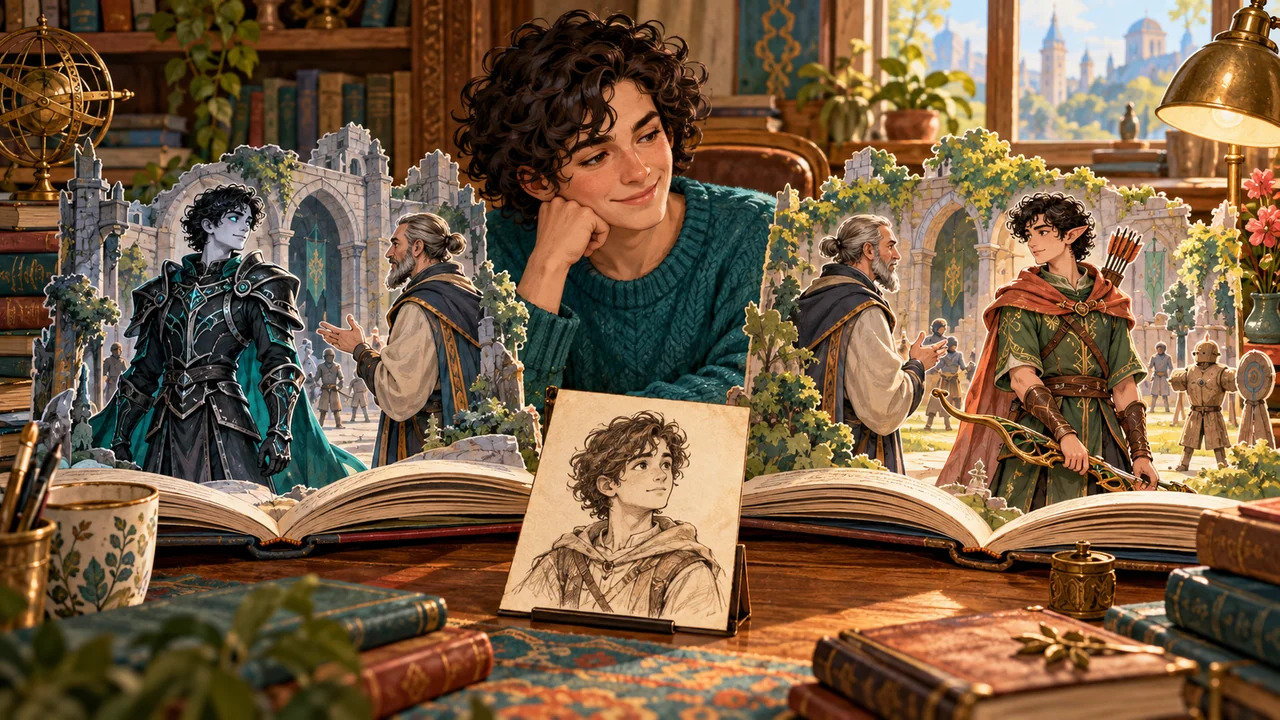
His name is still Kane, but he has become a different person
You bring both versions of Kane home.
Each enters the same training ground, meets the same instructor, and hears the same name called out.
But in one version, Kane has accepted the Black Knight’s pact and later undergone a ritual that transforms him into an undead Death Knight.
In the other, he has left his original path, studied archery and magic with a mentor, and become an elven Arcane Archer after a forest ritual.
The instructor remembers an apprentice knight who could barely hold his sword steady.
The person standing before him no longer matches that memory.
This is part of the appeal of parallel universe fiction.
The same name can return with an entirely different history.
The difference goes beyond equipment.
The character may have a different identity, bear different costs, or belong to a different organization. Changes in race and class may alter how he lives in the world.
If you only give the two versions different dialogue, much of that weight can be lost.
Parallel worlds change more than what happens to a character.
They change what those experiences make of him, and when he begins to become someone else.
Start with the same person and write two histories of growth
Both paths can begin in exactly the same place.
Kane starts as a human apprentice knight.
He has not yet earned his later qualifications or accepted the pacts, training, and rituals that will change his identity.
From that shared starting point, you write two different paths.
| Story point | Black iron relic timeline | Runic bow timeline |
|---|---|---|
| Chapter 10: shared starting point | Human apprentice knight | Human apprentice knight |
| Chapter 16: first identity change | Human Black Knight | Human Archer |
| Chapter 24: later transformation | Undead Death Knight, following a ritual | Elven Arcane Archer, following a different ritual |
This is not a class progression tree built into InkWeave.
Picking up the black iron relic does not automatically unlock the Death Knight class.
After acquiring an item, whether Kane accepts a pact, who he studies with, which ritual he takes part in, and whether his identity ultimately changes are all decisions you make as the author.
He could obtain the relic and refuse the Black Knight’s path.
He could carry the runic bow for a long time, then decide to return to the order of knights.
Acquiring an item and changing identity are separate events.
They can be causally connected, but the story must establish that connection.
The same applies to race.
Kane begins as a human, but that does not mean every version must keep him human forever.
You can define transformations, curses, rituals, or other rules that make a change of race an event in the manuscript.
Then “elven Arcane Archer” becomes more than a background description on his character sheet.
It has a point at which it becomes true.
Before that point, he is still the Kane who has not yet undergone the transformation.
A class change happens at a moment; it doesn’t overwrite the character sheet
After a character changes class, the most obvious way to organize the information is to replace the class on his character sheet.
Apprentice knight becomes Black Knight.
Black Knight becomes Death Knight.
That preserves the latest answer.
But when you return to Chapter 10, a sheet that still shows Death Knight can bring the later character back into the past.
InkWeave separates two things:
The character’s initial identity.
And the identity changes that happen later in the manuscript.
You can set “Human Apprentice Knight” as Kane’s initial identity.
When you write the scene in which he accepts the Black Knight’s identity, select the new identity in the Inspector and insert the change at your current position in the manuscript.
You don’t need to create his entire character sheet again.
Nor do you need to overwrite his initial identity.
Within the project, you can define race-and-class combinations such as “Human Black Knight” and “Undead Death Knight” according to the needs of your story.
If the story only needs an apprentice knight for now, start there.
Add the next identity when you reach the next transformation. You don’t have to define every possible class before Chapter 1.
If Kane later regains an identity he once held, record another change at that new point in the story.
Becoming a knight again does not mean he was never a Black Knight.
That history remains. From a later point onward, the world simply presents him under a different identity again.
This is the distinction between initial settings and events in the manuscript.
If you realize Kane should have had a different identity from the beginning, correct the initial setting.
If he changes during the story, leave the change where it happened.
One character doesn’t need every class’s attributes
Different identities may have different attributes.
You can define shared attributes for all characters, such as Stamina, Stress, or other states everyone in this world can experience.
You can also define attributes specific to an identity.
A Black Knight might have Oath Cost.
An undead Death Knight might have Soul Energy.
An Arcane Archer might have Focus and Runic Mana.
You decide what these attributes are called and what they mean.
| Attribute setup | Black iron relic timeline | Runic bow timeline |
|---|---|---|
| Shared attributes | Stamina, Stress, and other shared stats | The same shared definitions, with values shaped by this timeline’s own events |
| Identity-specific attributes | Oath Cost or Soul Energy, depending on his identity at that point | Focus or Runic Mana, depending on his identity at that point |
| Source of value changes | Expenditure, gains, and other changes you confirm in this timeline | Corresponding events you confirm in the other timeline |
| Before the transformation | Relevant attributes are shown for his identity then | Later identity-specific attributes are not treated as part of his earlier state |
In InkWeave, shared attributes can be displayed across identities.
Identity-specific attributes are filtered according to the character’s identity at that point in the story.
Your apprentice knight does not need to carry every Death Knight and Arcane Archer field from Chapter 1.
Create an attribute when you need to track it.
When its value actually increases or decreases, record that change in the manuscript.
Changing class does not automatically increase, refill, or reset every attribute.
Which values should change still depends on the rules you have defined and the changes you confirm.
The purpose is not to make character information more complicated.
It is to make the information you see correspond to the person you are writing about:
What identity he acts under now.
Which states he is experiencing.
And which changes have already happened.
Move the cursor into the past, and you see who he was then
You don’t have to keep cross-checking character sheets and chapter summaries to establish who Kane is at this moment.
When you write about a character you have already created in InkWeave, the scene-aware view can show the portrait you supplied, his location, other characters present, and his organizational affiliation.
The Inspector shows his identity and relevant attributes at the cursor’s position in the story.
Move the cursor to Chapter 10.
Kane is still a human apprentice knight.
Move past the identity change in Chapter 16.
The black iron relic version shows a human Black Knight.
The runic bow version shows a human Archer.
Only when you reach the scenes after the later transformation in Chapter 24 does the world reflect the subsequent changes in race and class.
You are not being asked to select his identity again every time you move the cursor.
The changes you have confirmed remain recorded along the manuscript.
The causality engine derives the state from events that have happened before your current position. The scene-aware view and Inspector bring the relevant answers into view.
If you want to know how he became the person he is now, open his identity change history.
Otherwise, continue writing his actions, dialogue, and choices.
Even if both versions use the same name and character portrait, the states shown alongside them can differ.
His portrait is not automatically redrawn when he changes class. But his identity, attributes, and relationships with the world at that moment reveal what has accumulated behind the name.
The feedback stays beside the manuscript. It does not turn every change of focus into another question you must answer.
Check when you want to confirm something.
When a transformation happens, select it and insert the event.
The story continues in your sentences, while the character’s past no longer has to remain only in your head.
Behind this is InkWeave’s own custom-built causality engine.
It is not AI guessing which class Kane most resembles from the surrounding prose.
His identity at a given point comes from his initial settings and the identity changes confirmed before that point.
His attribute states are derived from the definitions and events you have established.
These answers have an explicit computational basis. They do not depend on an AI impression of the character.
Identity, affiliation, and life status are separate things
Does becoming a Black Knight mean joining an order of knights?
Not necessarily.
Does becoming an elf mean earning the trust of a forest organization?
Not necessarily, either.
And does the name Death Knight mean the causality engine should treat him as dead and unable to act?
A name alone cannot decide that.
These things may influence one another in the story, but they answer different questions.
| World data | What it answers | Changes to confirm |
|---|---|---|
| Race and class identity | What is he at this point in the story? | Identity change events |
| Character attributes | What tracked values and states does he have? | Corresponding attribute changes |
| Organizational affiliation | Who has he joined, and where does he fit in the hierarchy? | Joining, leaving, or hierarchy changes |
| Life status | Is he dead, missing, or still able to act? | Corresponding status events |
You could write Black Knight Kane joining the capital’s garrison.
You could also have him refuse every organization and answer only to his own pact.
The Arcane Archer could join the Forest Wardens.
Or he could oppose them while keeping the same class.
Membership should change when you confirm someone joining or leaving.
Then, when you write about Kane or the organization again, the scene-aware view and Inspector can show his affiliation at that point and let you inspect the organization chart as it was then.
The Death Knight requires the same care.
If you define this as an undead identity that can still act, the word “death” in the title should not automatically turn him into a dead character who has left the story.
If he actually dies and later undergoes resurrection or another transformation, record the changes to his life status separately.
The causality engine does not interpret every title for you.
It maintains the identities, states, and events you have explicitly defined.
That separation leaves room for more complex combinations.
His identity changes, but his organization does not.
He leaves an organization without losing his class.
He gains power while still carrying the stress he had before.
The story can decide all of these.
Each path keeps its own growth, without borrowing from another future
In parallel universe fiction, the details most easily confused are not always major events.
Sometimes it is an identity that has become familiar.
You grow used to Kane as a Death Knight. When you return to an early chapter, you instinctively interpret his actions through the person he becomes later.
Or, while writing the Arcane Archer version, you forget that he never made the pact from the other path.
The name is the same.
The history is not.
Each timeline needs its own chapters, character data, and identity changes.
Want each character path to retain its complete story and world data?
Follow the What If Branching and Multiverse Story Tutorial to save and switch between story versions.
This uses the external workflow described in the tutorial. InkWeave does not automatically generate class progression paths. Completely close InkWeave before carrying out the steps.
The version-saving workflow can be used with the free edition. The causality engine, scene awareness, and advanced features such as identity changes within the manuscript are Pro features.
When you reopen a version, InkWeave presents the character according to that version’s own data and events.
It does not borrow an identity from another future.
Nor can it know qualifications or abilities you have not defined or recorded.
How abilities are used, how other people see Kane, and what an identity means to him remain yours to write.
But the transformations you have confirmed can stay faithfully recorded where they happened.
Kane can become a Death Knight in one path and an Arcane Archer in another.
Later, he could put aside his power and regain an identity he once held.
Wherever he ends up, the latest character sheet should not erase the people he was along the way.
The appeal of parallel worlds goes beyond giving one person several different sets of equipment.
Different choices let him live different histories.
You continue writing his adventure.
InkWeave brings his location, identity, and state at that moment into view.
His name stays the same.
Each timeline brings him back with a different past.